Some thirst remains even after life gives us what we thought we wanted. Beside Jacob’s well, Jesus meets a woman who is fully known and offers her the living water only God can give.
This New Day Focus devotional follows John 4 through spiritual thirst, truth without humiliation, worship in spirit and truth, and the simple witness that leads a Samaritan city toward Jesus.
“Whoever drinks of the water that I will give him will never thirst again.”
John 4:14, World English Bible
The Gospel Reading
John 4:4–30 and 39–42. World English Bible, public domain.
4 He needed to pass through Samaria.
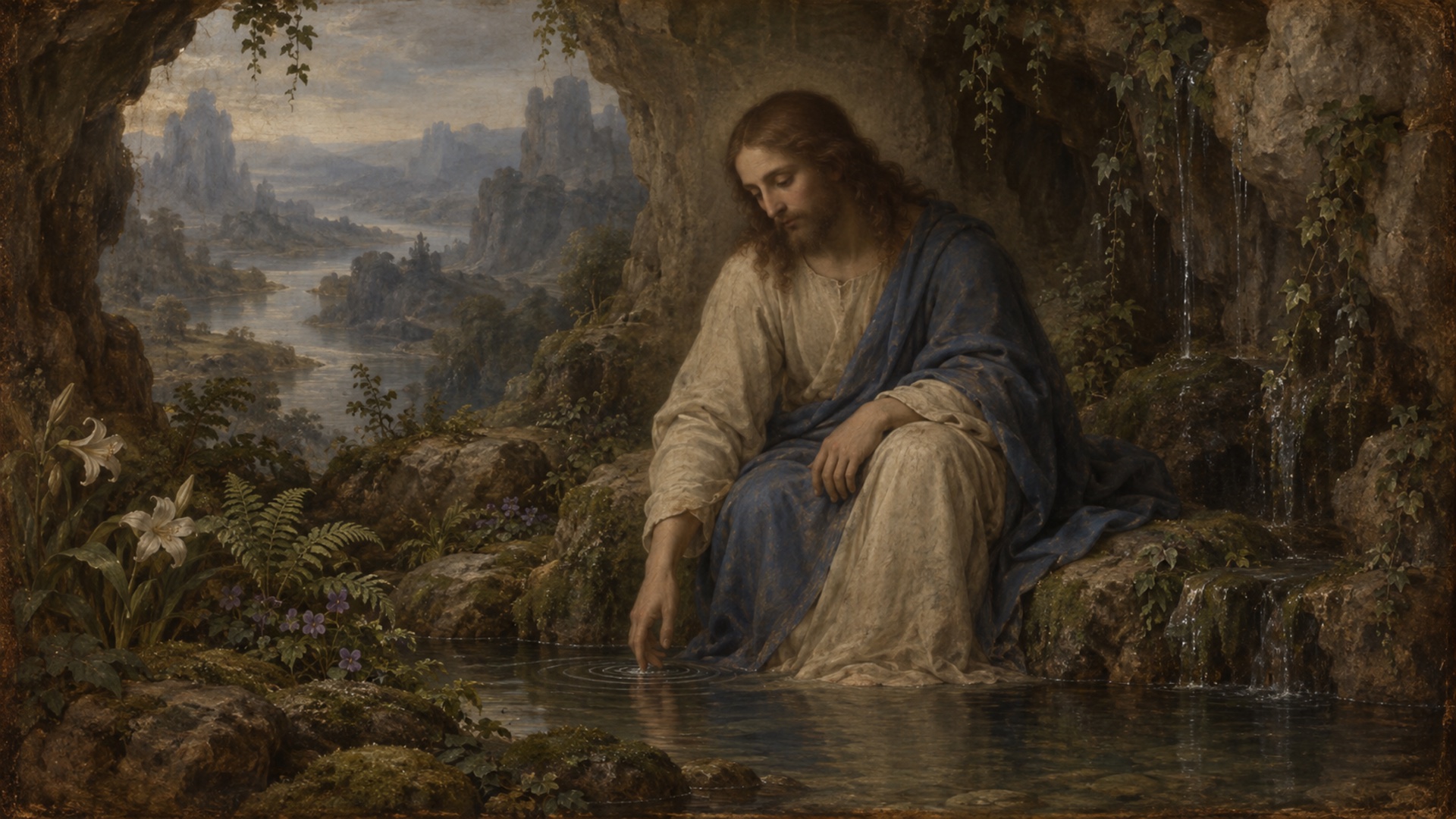
5 So he came to a city of Samaria called Sychar, near the parcel of ground that Jacob gave to his son Joseph. 6 Jacob’s well was there. Jesus therefore, being tired from his journey, sat down by the well. It was about the sixth hour.
7 A woman of Samaria came to draw water. Jesus said to her, “Give me a drink.” 8 For his disciples had gone away into the city to buy food.
9 The Samaritan woman therefore said to him, “How is it that you, being a Jew, ask for a drink from me, a Samaritan woman?” (For Jews have no dealings with Samaritans.)
10 Jesus answered her, “If you knew the gift of God, and who it is who says to you, ‘Give me a drink,’ you would have asked him, and he would have given you living water.”
11 The woman said to him, “Sir, you have nothing to draw with, and the well is deep. So where do you get that living water? 12 Are you greater than our father Jacob, who gave us the well and drank from it himself, as did his children and his livestock?”
13 Jesus answered her, “Everyone who drinks of this water will thirst again, 14 but whoever drinks of the water that I will give him will never thirst again; but the water that I will give him will become in him a well of water springing up to eternal life.”
15 The woman said to him, “Sir, give me this water, so that I don’t get thirsty, neither come all the way here to draw.”
16 Jesus said to her, “Go, call your husband, and come here.”
17 The woman answered, “I have no husband.”
Jesus said to her, “You said well, ‘I have no husband,’ 18 for you have had five husbands; and he whom you now have is not your husband. This you have said truly.”
19 The woman said to him, “Sir, I perceive that you are a prophet. 20 Our fathers worshiped in this mountain, and you Jews say that in Jerusalem is the place where people ought to worship.”
21 Jesus said to her, “Woman, believe me, the hour is coming when neither in this mountain nor in Jerusalem will you worship the Father. 22 You worship that which you don’t know. We worship that which we know; for salvation is from the Jews. 23 But the hour comes, and now is, when the true worshipers will worship the Father in spirit and truth, for the Father seeks such to be his worshipers. 24 God is spirit, and those who worship him must worship in spirit and truth.”
25 The woman said to him, “I know that Messiah is coming, he who is called Christ. When he has come, he will declare to us all things.”
26 Jesus said to her, “I am he, the one who speaks to you.”
27 Just then, his disciples came. They marveled that he was speaking with a woman; yet no one said, “What are you looking for?” or, “Why do you speak with her?” 28 So the woman left her water pot, went away into the city, and said to the people, 29 “Come, see a man who told me everything that I have done. Can this be the Christ?” 30 They went out of the city, and were coming to him.
39 From that city many of the Samaritans believed in him because of the word of the woman, who testified, “He told me everything that I have done.” 40 So when the Samaritans came to him, they begged him to stay with them. He stayed there two days. 41 Many more believed because of his word. 42 They said to the woman, “Now we believe, not because of your speaking; for we have heard for ourselves, and know that this is indeed the Christ, the Savior of the world.”
A Quiet Guide to This Passage
- Name the places where you keep returning to something that cannot satisfy your deepest need.
- Notice how Jesus speaks truth without stripping the Samaritan woman of dignity.
- Receive worship as a life opened honestly to the Father in spirit and truth.
- Let a genuine encounter with Christ become a simple invitation for others to meet him.
Extended Devotional Reflection
This extended written reflection follows the same Gospel passage and themes as the video, with additional space for prayerful reading.
When Your Soul Still Feels Thirsty
Some thirst remains even after life gives us what we thought we wanted. We can reach the goal, receive the approval, repair the schedule, or finally gain a little comfort, yet a quiet emptiness returns. Jesus understands that deeper thirst. In John chapter 4, he meets a woman beside a well and speaks to the part of her life that ordinary water cannot reach. He does not shame her for being thirsty, and he does not offer a temporary distraction. He offers living water, a gift of God that becomes a spring within the person who receives it. If your heart feels tired from searching, hiding, or carrying what no one else sees, this passage invites you to sit near Jesus and hear what he gives.
Welcome to New Day Focus. Today we enter the story of Jesus and the Samaritan woman, a conversation filled with physical weariness, social barriers, honest truth, and unexpected grace. The scene begins at midday beside Jacob’s well. Jesus is tired from the journey, the disciples have gone into the city, and a woman arrives carrying the ordinary burden of drawing water. By the time she leaves, her jar remains behind and her life is moving in a new direction. As we listen, imagine the heat resting over the hills, the depth of the old well, and the quiet attention of Jesus. He knows the whole story of the person before him, yet his first movement is toward relationship.
Our reading is John chapter 4, verses 4 through 30, and verses 39 through 42, from the World English Bible. “He needed to pass through Samaria. So he came to a city of Samaria called Sychar, near the parcel of ground that Jacob gave to his son Joseph. Jacob’s well was there. Jesus therefore, being tired from his journey, sat down by the well. It was about the sixth hour. A woman of Samaria came to draw water. Jesus said to her, ‘Give me a drink.’ For his disciples had gone away into the city to buy food.
“The Samaritan woman therefore said to him, ‘How is it that you, being a Jew, ask for a drink from me, a Samaritan woman?’ For Jews have no dealings with Samaritans. Jesus answered her, ‘If you knew the gift of God, and who it is who says to you, “Give me a drink,” you would have asked him, and he would have given you living water.’
“The woman said to him, ‘Sir, you have nothing to draw with, and the well is deep. So where do you get that living water? Are you greater than our father Jacob, who gave us the well and drank from it himself, as did his children and his livestock?’ Jesus answered her, ‘Everyone who drinks of this water will thirst again, but whoever drinks of the water that I will give him will never thirst again; but the water that I will give him will become in him a well of water springing up to eternal life.’
“The woman said to him, ‘Sir, give me this water, so that I don’t get thirsty, neither come all the way here to draw.’ Jesus said to her, ‘Go, call your husband, and come here.’ The woman answered, ‘I have no husband.’ Jesus said to her, ‘You said well, “I have no husband,” for you have had five husbands; and he whom you now have is not your husband. This you have said truly.’
“The woman said to him, ‘Sir, I perceive that you are a prophet. Our fathers worshiped in this mountain, and you Jews say that in Jerusalem is the place where people ought to worship.’ Jesus said to her, ‘Woman, believe me, the hour is coming when neither in this mountain nor in Jerusalem will you worship the Father. You worship that which you don’t know. We worship that which we know; for salvation is from the Jews. But the hour comes, and now is, when the true worshipers will worship the Father in spirit and truth, for the Father seeks such to be his worshipers. God is spirit, and those who worship him must worship in spirit and truth.’
“The woman said to him, ‘I know that Messiah is coming, he who is called Christ. When he has come, he will declare to us all things.’ Jesus said to her, ‘I am he, the one who speaks to you.’ Just then, his disciples came. They marveled that he was speaking with a woman; yet no one said, ‘What are you looking for?’ or, ‘Why do you speak with her?’ So the woman left her water pot, went away into the city, and said to the people, ‘Come, see a man who told me everything that I have done. Can this be the Christ?’ They went out of the city, and were coming to him.
“From that city many of the Samaritans believed in him because of the word of the woman, who testified, ‘He told me everything that I have done.’ So when the Samaritans came to him, they begged him to stay with them. He stayed there two days. Many more believed because of his word. They said to the woman, ‘Now we believe, not because of your speaking; for we have heard for ourselves, and know that this is indeed the Christ, the Savior of the world.’”
The first thing John tells us is that Jesus needed to pass through Samaria. The sentence carries more than travel information. Many Jewish travelers avoided Samaritan territory because of long hostility between the communities, but Jesus moves directly through the place others might bypass. His path leads toward a person who would not have expected a Jewish teacher to address her with dignity. Grace often begins this way. Christ enters the places we assume he will avoid. He is not controlled by old divisions, public suspicion, or the boundaries people use to decide who belongs near God.
John also tells us that Jesus was tired from the journey. This simple detail is deeply comforting. The Son of God sits beside the well in genuine human weariness. He does not move through the world untouched by dust, heat, hunger, or fatigue. When you come to him exhausted, you are not speaking to someone who regards human weakness from a distance. Jesus knows what it is to need rest and to feel the limits of a body. His weariness does not prevent him from seeing the woman, and her need does not cause him to pretend that he has none. Their conversation begins with shared human reality.
Jesus says, “Give me a drink.” He places himself in the position of receiving, which surprises the woman and opens the conversation. She knows the social distance between them. She is a Samaritan, he is a Jew, and the customs of the time give her every reason to expect silence. Jesus does not deny the history behind her question, but he refuses to let hostility have the final word. By asking for water, he honors her ability to give. Before he speaks about the gift she needs, he allows her to see that he is willing to receive from her hands.
This is part of the tenderness of Christ. He does not approach people as objects to be repaired. He meets them as persons who can speak, respond, question, and offer something. Even when he knows far more than the woman understands, he does not rush past her voice. Their conversation unfolds through her confusion and honest resistance. If you have ever feared that faith requires you to stop asking questions, watch Jesus at the well. He listens to what she actually says and guides her toward truth without crushing her dignity.
Then Jesus turns the conversation toward the gift of God. “If you knew the gift of God, and who it is who says to you, ‘Give me a drink,’ you would have asked him, and he would have given you living water.” The woman sees a tired traveler without a bucket. Jesus invites her to recognize the one who can give what no rope can reach and no container can hold. Her attention remains on the depth of the well, while his attention is on the deeper thirst of the human heart.
We understand her practical question. The well is deep, Jesus has nothing with which to draw, and living water sounds impossible in the visible circumstances. We often make the same calculation. We look at our limited resources, our long history, or the depth of the need and conclude that change cannot come. Jesus does not dismiss the depth. He reveals that the gift does not depend on the tools we can see. The grace of God is not trapped at the bottom of our ability. It comes from Christ himself.
“Everyone who drinks of this water will thirst again,” Jesus says. He is not criticizing ordinary water. The body needs it, and the woman’s work matters. He is naming the limitation of every created thing. Food satisfies and hunger returns. Rest restores us and weariness comes again. Success encourages us and eventually another uncertainty appears. Human affection is precious, yet no person can bear the entire weight of another soul. Trouble begins when we demand eternal satisfaction from gifts that were never meant to become God.
Much of our restlessness grows from returning to the same well and expecting a different kind of water. We may seek worth through constant productivity, hoping the next accomplishment will finally quiet the fear that we are not enough. We may depend on approval, checking the reactions of others until our peace rises and falls with every response. We may use entertainment to avoid silence or keep old resentment because it gives us a sense of control. These wells can offer a moment of relief, but they cannot become a spring of eternal life.
Jesus offers living water that becomes a well within. The image is generous and active. He does not describe a small ration that must be earned again each day. The life he gives rises from within because the Spirit of God dwells with his people. This does not mean believers never feel grief, loneliness, or physical need. It means those experiences no longer have to define the deepest truth about us. Beneath changing emotions and circumstances, the life of Christ remains a source that the world did not create and cannot take away.
The woman asks for this water, but she is still thinking about the daily walk to the well. Jesus responds by bringing the conversation toward her personal history. “Go, call your husband, and come here.” Her answer is brief: “I have no husband.” Jesus confirms that she has spoken truthfully, then reveals that he knows the complicated reality behind her words. The passage does not invite us to invent details or treat her life as entertainment. It asks us to notice that Jesus knows her truth and continues the conversation.
Being fully known can feel frightening because we expect exposure to end in rejection. Many people become skilled at presenting the manageable parts of their story while guarding whatever might change how others see them. We may even bring a carefully edited self into prayer. Yet Jesus already knows the places we avoid, and his knowledge is joined to holy love. He does not call darkness light, but neither does he use truth as a weapon. He brings the hidden life into the open so that grace can reach the person rather than the image.
The woman discovers that the one speaking with her knows what she has done. Later, this becomes part of her testimony. The very truth that might have caused her to flee becomes evidence that she has encountered someone extraordinary. Christ’s knowledge does not imprison her in the past. It becomes the doorway to a new future. This is what grace does. It allows us to say, “He knows,” without ending the sentence in despair. We can add, “and he still speaks to me, still offers life, and still calls me toward truth.”
Perhaps there is a part of your story you fear bringing before God. You may carry regret about a relationship, a decision, an addiction, or years that feel wasted. Avoiding the truth cannot heal it, but meeting Christ within the truth can begin something new. Confession is not informing God of what he missed. It is agreeing to stop hiding from the one who already knows and still draws near. His purpose is not humiliation. His purpose is freedom shaped by truth.
The conversation turns toward worship. The woman raises the long dispute about the proper place, whether on the Samaritan mountain or in Jerusalem. Jesus answers with both clarity and a wider promise. Salvation is from the Jews, yet the hour is coming when worship will not be contained by either location. True worshipers will worship the Father in spirit and truth, and the Father seeks such people. The living water Jesus gives creates a life turned toward God from within.
Worship in spirit and truth is more than singing in a particular building, though gathered worship is a gift. It is the honest response of the whole person to the God revealed in Christ. Spirit without truth can dissolve into whatever feeling seems powerful at the moment. Truth without the living work of the Spirit can become cold information held at a distance. Jesus brings them together. God seeks worship that is alive, sincere, grounded in who he is, and open to his transforming presence.
This means you can worship God in the ordinary place where you find yourself today. You do not need ideal surroundings before turning toward him. A kitchen before sunrise, a parked car, a hospital room, a quiet office, or a tired walk home can become a place of honest worship. The location does not make the moment sacred by itself. The Father is present, and he receives the person who comes through Christ with truth in the heart.
The woman speaks of the coming Messiah, the one who will explain all things. Jesus answers with remarkable directness: “I am he, the one who speaks to you.” The person she has been waiting for is already sitting beside the well. She began by seeing a Jewish stranger, then called him sir, recognized a prophet, and finally heard him identify himself as the Christ. Her understanding grows through conversation. Jesus patiently leads her from surprise toward recognition.
Faith often grows this way. We may begin with curiosity, a need, or a question we cannot resolve. As we remain with the words of Jesus, his identity becomes clearer. The goal is not merely to receive an answer about life while keeping him at the edge. The gift of God is inseparable from the giver. Living water comes through knowing Christ. He does more than explain our thirst. He gives himself as Savior.
When the disciples return, the woman leaves her water jar and goes into the city. John does not say that she deliberately abandoned it forever, yet the detail captures the change in urgency. The task that brought her to the well is no longer the largest thing in view. She has met someone who knows her fully and speaks of eternal life. She goes to the very people who know her history and says, “Come, see a man who told me everything that I have done. Can this be the Christ?”
Her invitation is simple, honest, and free from performance. She does not claim to understand every doctrine or answer every objection. She tells what happened and directs attention toward Jesus. This is a beautiful picture of witness. We do not need to make ourselves the center or pretend that faith has removed every question. We can say what Christ has done, speak of the mercy we have encountered, and invite others to come near enough to listen for themselves.
Many Samaritans believe because of her testimony, then their faith deepens through their own encounter with Jesus. They ask him to stay, and he remains for two days. The one who was expected to pass through becomes a welcomed guest. The people later say that they have heard for themselves and know he is the Savior of the world. The story moves from a solitary conversation beside a well to a community receiving Christ. Grace given to one person begins to flow outward like living water.
The phrase “Savior of the world” brings the whole passage into focus. Jesus crosses a contested boundary because his saving purpose is wider than the prejudice of any group. He speaks with a woman others might overlook, and through her testimony a city comes to hear him. No one is reduced to the category others have assigned. In Christ, outsiders are invited near, hidden histories are met with truth, and ordinary voices become carriers of good news.
This challenges the boundaries we maintain in our own hearts. We may not share the ancient conflict between Jews and Samaritans, but we know how easily suspicion grows. We sort people by background, politics, mistakes, education, personality, or social standing, then assume we know who will respond to grace. Jesus moves toward the person before him. Following him requires us to see individuals with patient attention and to refuse the comfort of contempt.
Living water also changes what we carry into relationships. When our souls are desperate for other people to complete us, every interaction becomes heavy with expectation. We may cling, control, withdraw, or resent because we are asking human love to become an infinite source. Receiving life from Christ does not make relationships unnecessary. It frees us to love others as gifts rather than use them as wells. We can give and receive with greater honesty because our deepest identity rests in the Savior.
If your soul feels thirsty today, begin by noticing where you have been returning for relief. Do not condemn yourself for having needs. Bring those needs into the light and ask what you have expected to satisfy them. Then hear the invitation of Jesus. He is not offering another technique for managing emptiness. He offers the gift of God, his own saving presence, and the life of the Spirit within.
You can respond with a simple prayer: “Jesus, give me this living water.” Let the words become more than a request for easier circumstances. Ask him to bring truth into what you hide, reorder what you love, and teach you to worship the Father from the heart. Open the Gospel again and remain with his voice. Grace often deepens as we stop rushing past the conversation.
There will still be practical work after prayer. The woman would need water again, and ordinary responsibilities would remain. Following Jesus does not remove us from daily life. It changes the source from which we enter it. We can work without asking achievement to tell us who we are. We can rest without believing that stillness makes us worthless. We can face painful truth without assuming it cancels our future. The spring of Christ’s life travels with us.
The abandoned jar can help us consider what we may need to set down, at least long enough to respond to Christ. Some burdens are responsibilities that must eventually be carried again, but they do not have to command every moment of our attention. Other burdens were never given by God. We may be carrying an old verdict spoken by someone who did not know our heart, or a private demand that we must prove our worth before we can be loved. When Jesus becomes clear, we can loosen our grip. What once seemed urgent can be placed in its proper order beneath the greater gift of knowing him.
The story also reminds us that spiritual renewal is received rather than manufactured. A spring rises because water is present at its source, not because the ground strains to produce it. In the same way, the life of the Spirit is not the reward for making ourselves impressive. We receive Christ through trust, then learn to remain open to his work. Prayer, Scripture, worship, and fellowship do not purchase living water. They make room for us to drink deeply from the grace already offered and to recognize where God is bringing growth.
If you feel dry because prayer has become difficult, begin with honesty rather than performance. Tell Jesus that your attention wanders, your hope feels thin, or your heart has been hurt. Read a small portion of the Gospel slowly and notice how he treats the person before him. Let one true sentence remain with you through the day. The woman at the well did not receive a complicated program. She remained in a real conversation with Jesus, and that encounter changed the direction of her life.
There is also encouragement here for anyone who feels disqualified from being useful to God. The woman has only recently understood who Jesus is, yet her invitation becomes the path by which others approach him. Her imperfect knowledge does not make her testimony worthless because she points beyond herself. God can use a sincere account of grace while he continues teaching the person who shares it. You do not need to become the answer to another person’s need. You can bear witness to the Savior and trust him to speak for himself.
Over time, living water becomes visible through the quality of a life. It may appear as patience that was once impossible, courage to tell the truth, compassion for someone previously avoided, or peace that does not depend on having every answer. Such fruit usually grows quietly. We may notice only small changes, but Christ is not limited by our impatience. The spring he gives is directed toward eternal life, and his faithful work reaches further than the emotional weather of a single day.
As this day unfolds, remember Jesus beside the well, tired yet attentive, truthful yet compassionate. He is not repelled by the depth of your need. He is not confused by the history behind it. He knows what cannot satisfy you and what can finally give life. The Savior of the world speaks personally, and his invitation remains open: ask, receive, and let his living water become a spring within you.
Let us pray. Lord Jesus, you know the thirst beneath our busyness and the needs we have tried to satisfy in places that cannot sustain us. Thank you for meeting us with patience and truth. Give us the living water that only you can provide. Let your Spirit renew what has become dry, awaken hope where disappointment has settled, and draw our hearts back to the Father.
Give us courage to be fully honest in your presence. Bring light to the parts of our story we have hidden through fear or shame, and help us trust that your knowledge is joined to mercy. Lead us away from habits that promise relief while deepening our emptiness. Teach us to receive created gifts with gratitude without asking them to become our savior.
Make our worship sincere, alive, and grounded in truth. Meet us in the ordinary places of this day and turn our attention toward you. Free us from prejudice and careless judgment. Help us see people as you see them, listen with dignity, and offer the hope of Christ without making ourselves the center.
For everyone who feels exhausted, lonely, or spiritually dry, let your presence become near and real. Strengthen those who are carrying regret. Comfort those who have been rejected. Give wisdom to those whose relationships feel complicated, and provide faithful companions for those who have walked alone. May your life rise within us with a strength that circumstances cannot create or remove.
Jesus, you are the Christ and the Savior of the world. We come to you with empty hands and ask for the gift of God. Fill us with your Spirit, shape us through your truth, and let the life you give flow outward in compassion, courage, and peace. We place this day before you and trust your grace for every step. In your name we pray. Amen.
May you leave this time as the woman left the well, not pretending that your story has never been difficult, but knowing that Christ has met you within it. May his living water refresh your soul, his truth make you free, and his presence become the deepest source of your hope. Thank you for spending this time with New Day Focus. Walk gently into the day, remembering that the Savior of the world knows you and still invites you near.
New Day Focus shares peaceful Gospel readings, thoughtful Christian devotionals, and prayer for the day ahead.