A man who has never seen the world meets Jesus, receives his sight, and then discovers that clear vision can require courage. John 9 is a healing story, but it is also a searching account of what happens when grace challenges the explanations people prefer to protect.
This reflection follows the man from the roadside to the pool of Siloam, through repeated questioning, and finally into a personal encounter with Jesus. His growing testimony invites us to recognize what Christ has done and remain truthful when others resist it.
“One thing I do know: that though I was blind, now I see.”
John 9:25, World English Bible
The Gospel Reading
John 9:1–41. World English Bible, public domain.
1 As he passed by, he saw a man blind from birth.
2 His disciples asked him, “Rabbi, who sinned, this man or his parents, that he was born blind?”
3 Jesus answered, “Neither did this man sin, nor his parents; but, that the works of God might be revealed in him.
4 I must work the works of him who sent me, while it is day. The night is coming, when no one can work.
5 While I am in the world, I am the light of the world.”
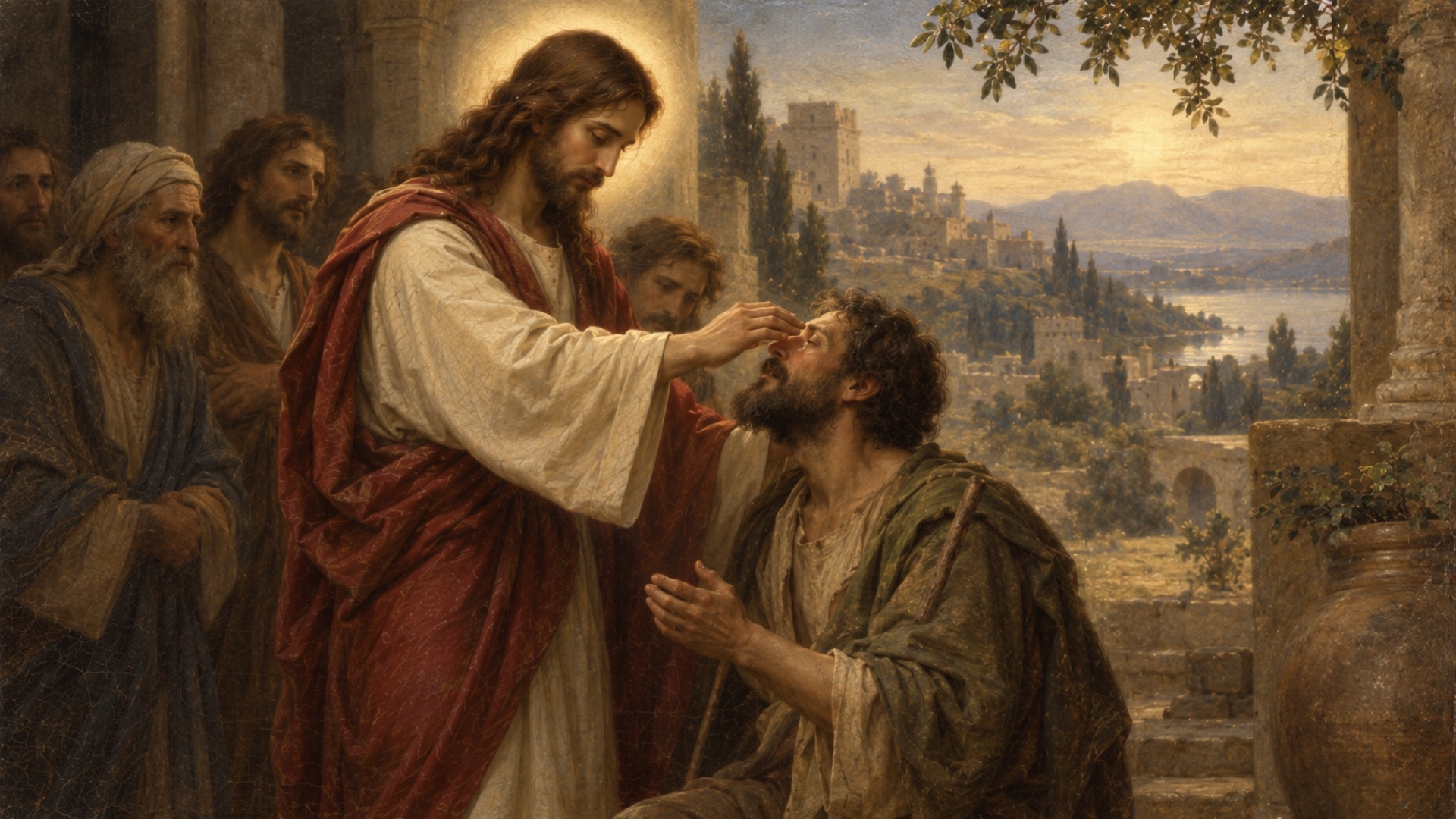
6 When he had said this, he spat on the ground, made mud with the saliva, anointed the blind man’s eyes with the mud,
7 and said to him, “Go, wash in the pool of Siloam,” which means “Sent”. So he went away, washed, and came back seeing.
8 The neighbors therefore, and those who saw that he was blind before, said, “Isn’t this he who sat and begged?”
9 Others were saying, “It is he.” Still others were saying, “He looks like him.” He said, “I am he.”
10 They therefore were asking him, “How were your eyes opened?”
11 He answered, “A man called Jesus made mud, anointed my eyes, and said to me, ‘Go to the pool of Siloam, and wash.’ So I went away and washed, and I received sight.”
12 Then they asked him, “Where is he?” He said, “I don’t know.”
13 They brought him who had been blind to the Pharisees.
14 It was a Sabbath when Jesus made the mud and opened his eyes.
15 Again therefore the Pharisees also asked him how he received his sight. He said to them, “He put mud on my eyes, I washed, and I see.”
16 Some therefore of the Pharisees said, “This man is not from God, because he doesn’t keep the Sabbath.” Others said, “How can a man who is a sinner do such signs?” There was division among them.
17 Therefore they asked the blind man again, “What do you say about him, because he opened your eyes?” He said, “He is a prophet.”
18 The Jews therefore did not believe concerning him, that he had been blind, and had received his sight, until they called the parents of him who had received his sight,
19 and asked them, “Is this your son, who you say was born blind? How then does he now see?”
20 His parents answered them, “We know that this is our son, and that he was born blind;
21 but how he now sees, we don’t know; or who opened his eyes, we don’t know. He is of age. Ask him. He will speak for himself.”
22 His parents said these things because they feared the Jews; for the Jews had already agreed that if any man would confess him as Christ, he would be put out of the synagogue.
23 Therefore his parents said, “He is of age. Ask him.”
24 So they called the man who was blind a second time, and said to him, “Give glory to God. We know that this man is a sinner.”
25 He therefore answered, “I don’t know if he is a sinner. One thing I do know: that though I was blind, now I see.”
26 They said to him again, “What did he do to you? How did he open your eyes?”
27 He answered them, “I told you already, and you didn’t listen. Why do you want to hear it again? You don’t also want to become his disciples, do you?”
28 They insulted him and said, “You are his disciple, but we are disciples of Moses.
29 We know that God has spoken to Moses. But as for this man, we don’t know where he comes from.”
30 The man answered them, “How amazing! You don’t know where he comes from, yet he opened my eyes.
31 We know that God doesn’t listen to sinners, but if anyone is a worshiper of God, and does his will, he listens to him.
32 Since the world began it has never been heard of that anyone opened the eyes of someone born blind.
33 If this man were not from God, he could do nothing.”
34 They answered him, “You were altogether born in sins, and do you teach us?” They threw him out.
35 Jesus heard that they had thrown him out, and finding him, he said, “Do you believe in the Son of God?”
36 He answered, “Who is he, Lord, that I may believe in him?”
37 Jesus said to him, “You have both seen him, and it is he who speaks with you.”
38 He said, “Lord, I believe!” and he worshiped him.
39 Jesus said, “I came into this world for judgment, that those who don’t see may see; and that those who see may become blind.”
40 Those of the Pharisees who were with him heard these things, and said to him, “Are we also blind?”
41 Jesus said to them, “If you were blind, you would have no sin; but now you say, ‘We see.’ Therefore your sin remains.”
A Quiet Guide to This Passage
- Release the need to explain every hardship before bringing it to Jesus.
- Obey the next clear instruction even when you cannot yet see the outcome.
- Tell the truth about what Christ has done without pretending to know everything.
- Ask Jesus to expose the kinds of certainty that keep the heart from seeing him.
Devotional Reflection
The disciples notice the man who was blind from birth and immediately ask whose sin caused his condition. Their question reflects a familiar desire to make suffering understandable by assigning blame. Jesus refuses the narrow choice they offer. He turns their attention from accusation toward the work of God that is about to become visible.
This response does not make the man’s long hardship small, and it does not teach that every painful event can be neatly explained. Jesus shows that suffering is not permission to reduce a person to a theory. The man is not a puzzle placed beside the road so that others can debate him. He is someone Jesus sees and approaches.
Jesus makes mud, places it on the man’s eyes, and tells him to wash in the pool of Siloam. The instruction asks for trust before sight. The man must walk while the darkness remains, carrying the words of Jesus with him. He goes, washes, and comes back seeing.
The healing should create uncomplicated joy, yet the questions begin almost immediately. Neighbors wonder whether he is really the same person. Religious leaders examine the timing of the miracle and become more concerned with defending their interpretation of the Sabbath than with receiving the evidence of a restored life. Even the man’s parents speak cautiously because they fear exclusion.
Throughout the chapter, the healed man grows clearer while the people questioning him become less willing to see. He begins by describing Jesus as the man who healed him. Later he calls him a prophet. Under pressure, he reasons that someone who opened the eyes of a man born blind must be from God. His understanding develops because he refuses to deny the truth he has received.
His testimony is wonderfully honest. He does not claim complete knowledge. He says that there are things he does not know, but he will not surrender the one thing he does know. He was blind, and now he sees. Mature faith does not require us to answer every objection before we speak. It asks us to tell the truth about the mercy we have encountered.
The authorities eventually throw him out. The cost of truthful witness becomes personal. He receives sight, yet loses the security of belonging to the community that should have celebrated him. John then gives one of the tenderest details in the passage: Jesus hears that they have cast him out and goes to find him.
Christ does not abandon the man after the public miracle. He meets him in the loneliness that follows. Jesus reveals himself as the Son of God, and the man responds with belief and worship. The deepest gift is not merely the ability to see the world. It is the grace to see Jesus and entrust himself to him.
The chapter closes with a warning about spiritual blindness. The people most confident that they see are the ones who resist the truth standing before them. Certainty can become a barrier when it protects status, habit, or pride. Humility begins by admitting that we need light from beyond ourselves.
If you are walking through a season you cannot explain, let Jesus meet you before every question is answered. Follow the next faithful instruction he has made clear. If grace has changed you, speak honestly without exaggeration. When truth costs you the approval of others, remember that Christ still knows where to find you.
Lord Jesus, open our eyes to your presence and free us from explanations that turn suffering into blame. Give us courage to obey before the outcome is visible and humility to admit what we do not know. Help us speak truthfully about your mercy, and find us when faithfulness leaves us feeling alone. Let us see you more clearly and worship you with an undivided heart. Amen.
New Day Focus shares peaceful Gospel readings, thoughtful Christian devotionals, and prayer for the day ahead.