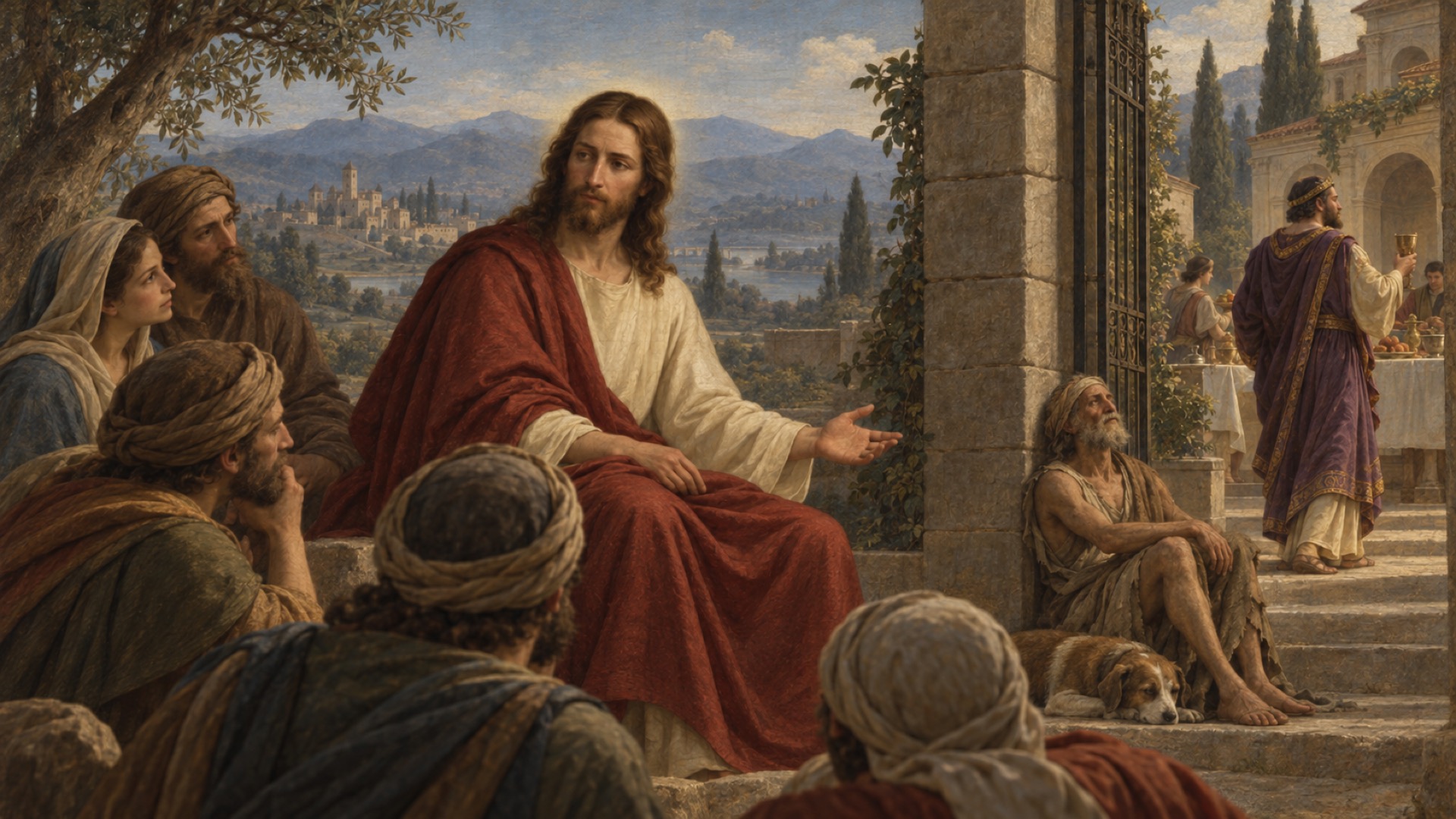
A lawyer asks Jesus where the boundary of love can be drawn. Jesus answers with a wounded traveler, two respected men who pass at a distance, and an unexpected neighbor whose compassion becomes practical care.
The Good Samaritan is not only a lesson about kindness. It is a call to let mercy interrupt our plans, cross the lines we use to separate people, and take responsibility for the person God has placed within reach.
“He who showed mercy on him. Then Jesus said to him, “Go and do likewise.””
Luke 10:37, World English Bible
The Gospel Reading
Luke 10:25–37. World English Bible, public domain.
25 Behold, a certain lawyer stood up and tested him, saying, “Teacher, what shall I do to inherit eternal life?”
26 He said to him, “What is written in the law? How do you read it?”
27 He answered, “You shall love the Lord your God with all your heart, with all your soul, with all your strength, and with all your mind; and your neighbor as yourself.”
28 He said to him, “You have answered correctly. Do this, and you will live.”
29 But he, desiring to justify himself, asked Jesus, “Who is my neighbor?”
30 Jesus answered, “A certain man was going down from Jerusalem to Jericho, and he fell among robbers, who both stripped him and beat him, and departed, leaving him half dead.
31 By chance a certain priest was going down that way. When he saw him, he passed by on the other side.
32 In the same way a Levite also, when he came to the place and saw him, passed by on the other side.
33 But a certain Samaritan, as he traveled, came where he was. When he saw him, he was moved with compassion,
34 came to him, and bound up his wounds, pouring on oil and wine. He set him on his own animal, brought him to an inn, and took care of him.
35 On the next day, when he departed, he took out two denarii, gave them to the host, and said to him, ‘Take care of him. Whatever you spend beyond that, I will repay you when I return.’
36 Now which of these three do you think seemed to be a neighbor to him who fell among the robbers?”
37 He said, “He who showed mercy on him.” Then Jesus said to him, “Go and do likewise.”
A Quiet Guide to This Passage
- Notice when the desire to define a neighbor becomes a way of limiting love.
- Allow compassion to move from feeling into attentive and practical care.
- Refuse to let social, religious, or cultural distance decide whose suffering matters.
- Choose one act of mercy that protects dignity and carries care beyond the first moment.
Devotional Reflection
The conversation begins with a serious question about eternal life, but Luke tells us that the lawyer is testing Jesus. When Jesus returns the question to him, the lawyer gives the right answer. Love God completely and love your neighbor as yourself. The difficulty is not knowing the words. It is allowing those words to govern the way we meet another person.
The lawyer asks who his neighbor is because he wants the command to have a clear boundary. If the category can be defined, then love can be measured and obligations can be limited. Jesus answers by telling a story in which the central question changes. Instead of asking which people qualify as neighbors, he asks what it means to become a neighbor.
A traveler is attacked on the dangerous road from Jerusalem to Jericho. The robbers strip him, beat him, and leave him unable to save himself. Jesus gives us no information about his identity or deservingness. The wounded man is known first through his need.
A priest sees him and passes on the other side. A Levite does the same. Jesus does not explain their motives, so the story does not allow us to excuse or condemn them through details that are not given. What matters is that both men see the suffering and create distance from it.
The Samaritan also sees the man, but the sight reaches his heart. Jews and Samaritans carried a history of religious and social hostility. Jesus deliberately makes the outsider the one whose response reflects the command of God. Mercy arrives through someone the lawyer would not have chosen as a model.
Compassion becomes action. The Samaritan approaches the wounded man, treats his injuries, lifts him onto his own animal, brings him to shelter, and remains involved in his care. He spends his time, strength, supplies, and money. The story refuses to separate a caring heart from practical responsibility.
Mercy also preserves the wounded man’s dignity. The Samaritan does not make a public performance of his generosity. He does not ask for recognition, and he does not use the man’s vulnerability to elevate himself. He quietly does what is needed and arranges for care to continue after he leaves.
Jesus asks which person proved to be a neighbor. The lawyer cannot avoid the answer, although he describes the Samaritan without naming his people. He says, ‘He who showed mercy on him.’ Jesus then gives a simple command: ‘Go and do likewise.’ The story moves from debate into discipleship.
We may be tempted to admire the parable while keeping it at a safe distance. Yet the road appears wherever someone’s need interrupts our efficiency or challenges our loyalties. Becoming a neighbor may involve listening without rushing, offering material help, protecting someone’s dignity, or staying involved after the first emotional moment has passed.
Wisdom and healthy boundaries still matter. Mercy is not the same as placing ourselves or others in danger, and no one person can respond to every need. The parable calls us to resist using complexity as a reason for habitual distance. We ask what faithful care is possible here, with this person, in this moment.
Lord Jesus, make our love more honest than our definitions. Give us eyes that do not turn away from suffering and hearts willing to be interrupted. Free us from prejudice, convenience, and the desire to appear compassionate without becoming involved. Show us the mercy that is possible today, and give us courage to go and do likewise. Amen.
New Day Focus shares peaceful Gospel readings, thoughtful Christian devotionals, and prayer for the day ahead.