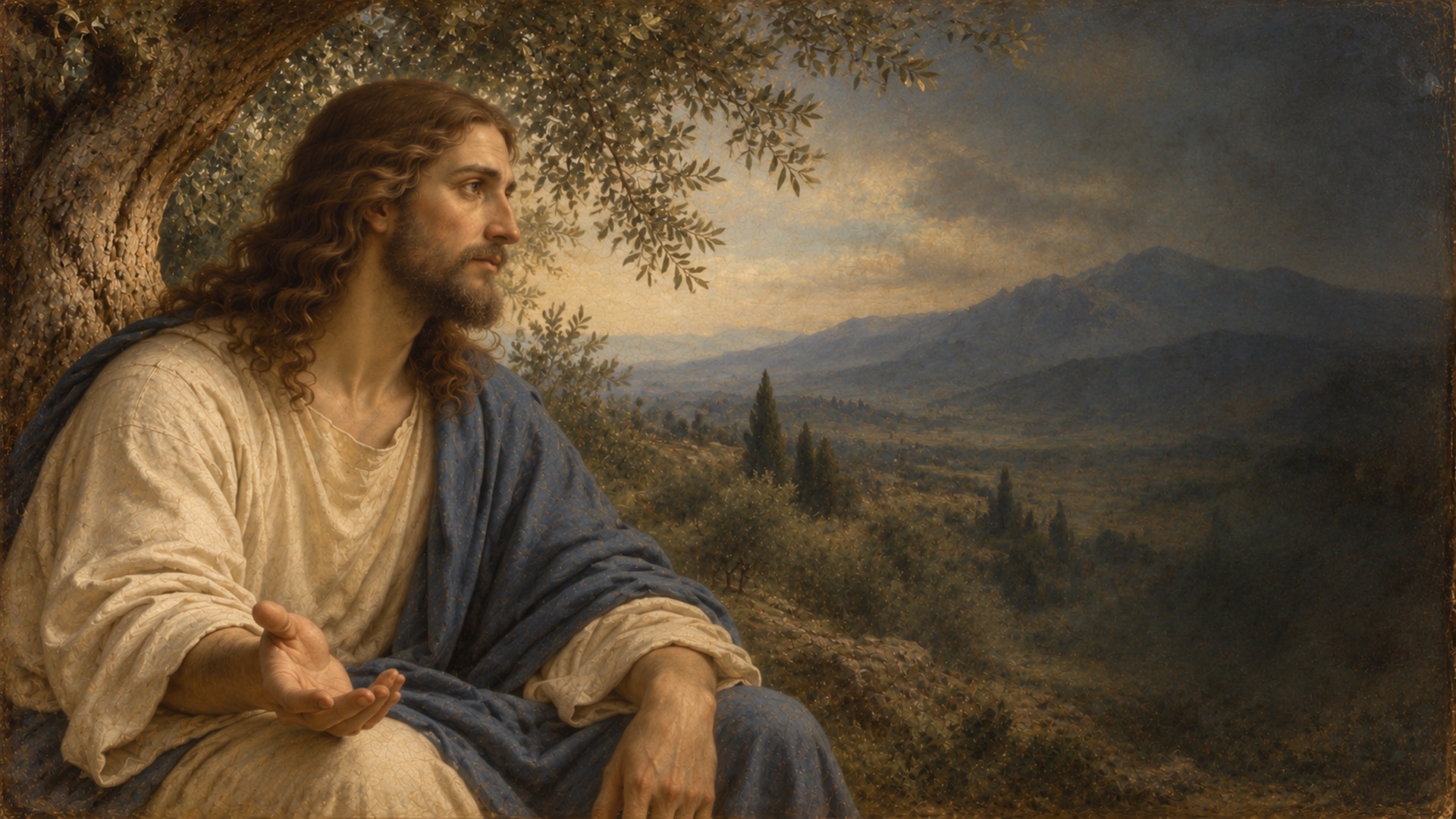
There are seasons when other people’s answers about Jesus are no longer enough. In the quiet near Caesarea Philippi, Jesus turns from public opinion to a personal question that reaches every generation: Who do you say that I am?
This reflection listens closely to the question Jesus asks his disciples, Peter’s confession that he is the Christ, and the difference between knowing what people say about Jesus and entrusting your own life to him.
“But who do you say that I am?”
Matthew 16:15, World English Bible
The Gospel Reading
Matthew 16:13–16 and Luke 9:18–20. World English Bible, public domain.
MATTHEW 16:13–16
13 Now when Jesus came into the parts of Caesarea Philippi, he asked his disciples, saying, “Who do men say that I, the Son of Man, am?”
14 They said, “Some say John the Baptizer, some, Elijah, and others, Jeremiah or one of the prophets.”
15 He said to them, “But who do you say that I am?”
16 Simon Peter answered, “You are the Christ, the Son of the living God.”
LUKE 9:18–20
18 As he was praying alone, the disciples were near him, and he asked them, “Who do the multitudes say that I am?”
19 They answered, “ ‘John the Baptizer,’ but others say, ‘Elijah,’ and others, that one of the old prophets has risen again.”
20 He said to them, “But who do you say that I am?”
Peter answered, “The Christ of God.”
A Quiet Guide to This Passage
- Notice the difference between repeating what others believe and answering Jesus personally.
- Bring uncertainty to Christ without pretending that every question has already been resolved.
- Let Peter’s confession shape how you understand the authority, mercy, and identity of Jesus.
- Allow what you believe about Jesus to guide the next faithful choice in your own life.
Devotional Reflection
Jesus asks this question in the region of Caesarea Philippi, a place filled with competing claims about power, worship, and authority. The setting matters because his question is not asked in a protected religious room where the answer seems obvious. It is spoken in a landscape crowded with other loyalties. The disciples must identify him while surrounded by voices that offer different explanations of who deserves trust.
He begins by asking what the crowds are saying. The answers are respectful. Some identify Jesus with John the Baptizer, Elijah, Jeremiah, or another prophet. People recognize that something holy and powerful is happening, yet admiration does not necessarily become recognition. A person can speak warmly about Jesus and still avoid the deeper claim he makes upon the heart.
Then Jesus narrows the question. He does not ask the disciples to improve the latest public opinion or win an argument about reputation. He asks what they themselves say. The word you makes the question personal. It removes the shelter of borrowed language and invites an answer rooted in relationship.
Many people reach a season when inherited answers feel less certain than they once did. Pain may unsettle beliefs that seemed simple. Disappointment may make prayer feel unfamiliar. Exposure to competing voices may create confusion. This passage does not shame the person who is wrestling. Jesus is the one who begins the conversation, and his presence makes honest reflection possible.
Peter answers, ‘You are the Christ, the Son of the living God.’ In Luke’s account, he says, ‘The Christ of God.’ The confession identifies Jesus as more than a teacher who offers useful wisdom. He is God’s anointed King, the one in whom God’s promise and saving purpose come near. Peter does not yet understand everything that this identity will mean, but he has seen enough to entrust his answer to Jesus.
That detail is encouraging because mature faith is not the same as complete understanding. Peter will still misunderstand the path of the cross. He will speak too quickly, become afraid, and eventually deny that he knows Jesus. His confession is real, but his formation is unfinished. Christ receives him at this stage and continues teaching him through failure, grace, and restoration.
When you do not know who Jesus is anymore, it may help to return to the Gospels before reaching for a slogan. Watch how he treats the overlooked, how he speaks truth without cruelty, how he welcomes children, confronts hypocrisy, forgives sinners, carries the cross, and rises from the grave. Let his life correct both sentimental pictures and harsh distortions.
The question also reaches beyond ideas into trust. If Jesus is the Christ, then his words deserve more than occasional agreement. His mercy can define us more deeply than shame. His authority can challenge the habits we protect. His presence can become the place where fear is brought into the light rather than hidden behind control.
Faith does not require us to ignore mystery. It asks us to respond to the One who stands before us. Peter’s answer is not a claim that he can explain every future event. It is a confession of identity and allegiance. He knows whom he is following, even though he still has much to learn about the road.
You may need to answer this question slowly today. Set aside what an opponent says about Jesus, what a disappointed person says, and even what a respected teacher says long enough to listen for your own response. Borrowed faith can introduce us to Christ, but only a personal encounter can sustain a life of discipleship.
Your answer will be expressed not only in words but in the direction of your trust. It appears in what you do with anxiety, whom you forgive, how you use influence, and where you seek your worth. No one lives this confession perfectly. The invitation is to let belief become relationship, and relationship become a daily way of following.
Lord Jesus, meet us where certainty has become difficult and where borrowed answers no longer satisfy. Reveal yourself through the truth of the Gospel. Give us humility to keep learning, courage to confess you as the Christ, and grace to live from that confession. Hold us through every unfinished part of our faith and lead us into deeper trust. Amen.
New Day Focus shares peaceful Gospel readings, thoughtful Christian devotionals, and prayer for the day ahead.