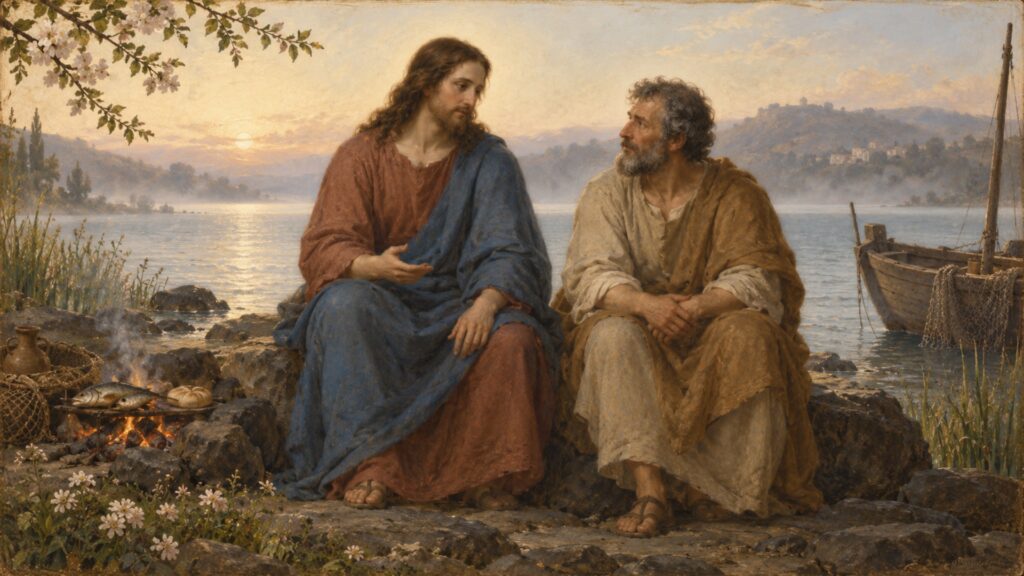
Jesus begins the parable of the sower with one urgent word: Listen. The same seed falls across every kind of ground, yet the condition of the soil shapes what happens after the word is heard.
This reflection considers the generous sower, the hardened path, shallow soil, crowded thorns, and the good ground that receives the word and allows patient fruitfulness to grow.
“Those which were sown on the good ground are those who hear the word, accept it, and bear fruit.”
Mark 4:20, World English Bible
The Gospel Reading
Mark 4:1–20. World English Bible, public domain.
1 Again he began to teach by the seaside. A great multitude was gathered to him, so that he entered into a boat in the sea and sat down. All the multitude were on the land by the sea.
2 He taught them many things in parables, and told them in his teaching,
3 “Listen! Behold, the farmer went out to sow.
4 As he sowed, some seed fell by the road, and the birds came and devoured it.
5 Others fell on the rocky ground, where it had little soil, and immediately it sprang up, because it had no depth of soil.
6 When the sun had risen, it was scorched; and because it had no root, it withered away.
7 Others fell among the thorns, and the thorns grew up and choked it, and it yielded no fruit.
8 Others fell into the good ground and yielded fruit, growing up and increasing. Some produced thirty times, some sixty times, and some one hundred times as much.”
9 He said, “Whoever has ears to hear, let him hear.”
10 When he was alone, those who were around him with the twelve asked him about the parables.
11 He said to them, “To you is given the mystery of God’s Kingdom, but to those who are outside, all things are done in parables,
12 that ‘seeing they may see and not perceive, and hearing they may hear and not understand, lest perhaps they should turn again, and their sins should be forgiven them.’”
13 He said to them, “Don’t you understand this parable? How will you understand all of the parables?
14 The farmer sows the word.
15 The ones by the road are the ones where the word is sown; and when they have heard, immediately Satan comes and takes away the word which has been sown in them.
16 These in the same way are those who are sown on the rocky places, who, when they have heard the word, immediately receive it with joy.
17 They have no root in themselves, but are short-lived. When oppression or persecution arises because of the word, immediately they stumble.
18 Others are those who are sown among the thorns. These are those who have heard the word,
19 and the cares of this age, and the deceitfulness of riches, and the lusts of other things entering in choke the word, and it becomes unfruitful.
20 Those which were sown on the good ground are those who hear the word, accept it, and bear fruit, some thirty times, some sixty times, and some one hundred times.”
A Quiet Guide to This Passage
- Ask what has made your attention hard, shallow, or crowded in this season.
- Receive the word of Jesus without demanding instant visible results.
- Make room for roots through prayer, Scripture, community, and patient obedience.
- Trust the generous sower to keep working while the hidden seed grows.
Devotional Reflection
Jesus teaches beside the sea while a great crowd gathers on the shore. He enters a boat, sits down, and speaks about a farmer scattering seed. The scene is familiar to his listeners, but the opening command asks for more than casual attention. ‘Listen’ means that the parable is already examining the posture of the hearer.
The farmer scatters seed across the path, rocky ground, thorns, and good soil. He appears almost extravagant because the seed is not reserved only for the places most likely to succeed. This generosity reflects the wide announcement of God’s kingdom. The word is offered before the condition of each heart is resolved.
The hardened path cannot receive the seed. Repeated traffic has pressed the ground until nothing can enter. Hearts can become similar through disappointment, cynicism, distraction, or pain that has never found a safe place to be acknowledged. Hardness is not always rebellion. Sometimes it began as protection.
Jesus does not tell the parable so that we can label other people’s soil. He invites honest attention to our own receptivity. If the heart has grown hard, the response is not shame. Soil can be opened again. Prayer, truth, grief, and patient trust can create space where the word is no longer kept on the surface.
The rocky ground receives the word with immediate joy, but the plant has no depth. When pressure comes, it withers. Enthusiasm is a gift, yet enthusiasm alone cannot sustain discipleship. Roots grow through repeated practices that may feel less dramatic than the first moment of inspiration.
A rooted life returns to Scripture when emotion is quiet, remains in community when relationships require patience, and continues praying when answers seem delayed. These practices do not earn growth. They create room for the word to reach deeper than changing circumstances.
The seed among thorns begins to grow, but the cares of the age, the deceitfulness of riches, and desires for other things crowd it. The threat is not always open rejection. The word can be slowly displaced by concerns that demand constant attention and promises that suggest peace will arrive only after we obtain more.
Thorns often grow without a deliberate decision. Schedules fill, worry multiplies, and comparison enters through ordinary habits. We may still agree with the Gospel while giving it little room to shape our choices. Clearing thorns means noticing what repeatedly consumes attention and asking whether it is helping love, trust, and truth grow.
Good soil hears, accepts, and bears fruit. Jesus does not describe fruit as instant perfection. Growth unfolds over time. The results vary, yet every fruitful life receives the same word and allows it to take root. Fruit may appear as patience under pressure, quiet generosity, honest repentance, forgiveness, or courage to serve.
The parable places responsibility on the hearer, but it also gives hope through the sower. God is generous with the seed. He is not reluctant to speak or eager to abandon difficult ground. The same heart may contain several kinds of soil in different seasons, and the work of grace can continue.
Resting in the word does not mean passive listening. It means allowing what Jesus says to remain with us long enough to challenge our defenses, deepen our roots, and reorder what has become crowded. We receive the word as something living that can produce what we cannot manufacture through pressure.
Lord Jesus, give us ears to hear and hearts willing to receive your word. Soften what disappointment has hardened, deepen what has remained shallow, and clear what anxiety has crowded. Teach us patient obedience while growth is hidden. Let your truth take root in us and bear fruit that nourishes the people around us. Amen.
New Day Focus shares peaceful Gospel readings, thoughtful Christian devotionals, and prayer for the day ahead.