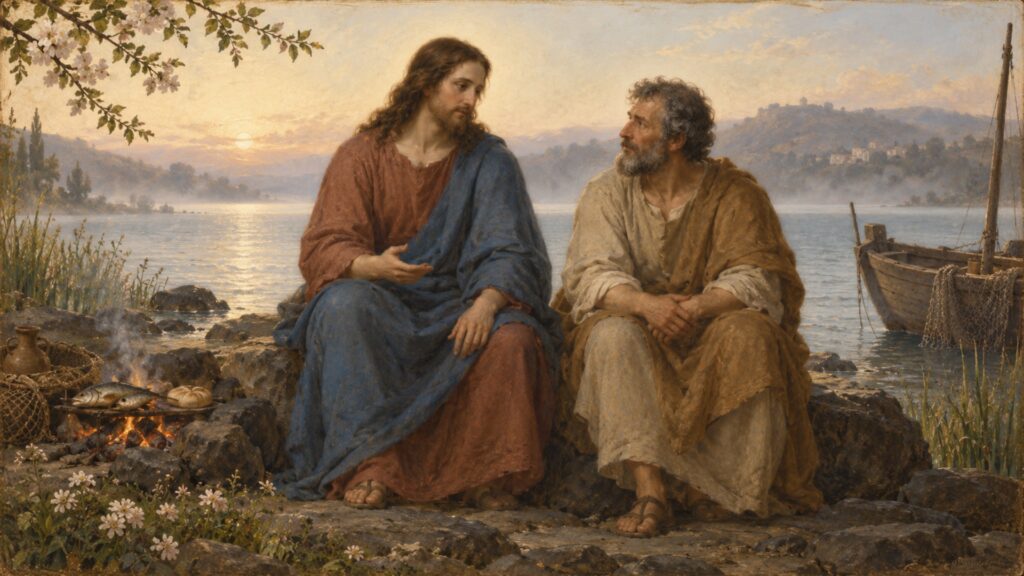
After twelve years of suffering, disappointment, and costly attempts to become well, one woman reaches toward Jesus in a crowded street. Her touch is almost hidden from everyone else, but it is not hidden from him.
This reflection follows Mark 5 through the woman’s long illness, her courageous approach, the question Jesus asks in the crowd, and the word of peace that restores more than her body.
“Daughter, your faith has made you well. Go in peace.”
Mark 5:34, World English Bible
The Gospel Reading
Mark 5:25–34. World English Bible, public domain.
25 A certain woman, who had an issue of blood for twelve years,
26 and had suffered many things by many physicians, and had spent all that she had, and was no better, but rather grew worse,
27 having heard the things concerning Jesus, came up behind him in the crowd, and touched his clothes.
28 For she said, “If I just touch his clothes, I will be made well.”
29 Immediately the flow of her blood was dried up, and she felt in her body that she was healed of her affliction.
30 Immediately Jesus, perceiving in himself that the power had gone out from him, turned around in the crowd, and asked, “Who touched my clothes?”
31 His disciples said to him, “You see the multitude pressing against you, and you say, ‘Who touched me?’”
32 He looked around to see her who had done this thing.
33 But the woman, fearing and trembling, knowing what had been done to her, came and fell down before him, and told him all the truth.
34 He said to her, “Daughter, your faith has made you well. Go in peace, and be cured of your disease.”
A Quiet Guide to This Passage
- Bring the place of long disappointment to Jesus without editing the truth of your experience.
- Notice the courage required for the woman to move through the crowd and reach for Christ.
- Receive the dignity in the name Jesus gives her: daughter.
- Let healing include peace, belonging, and truthful restoration rather than only relief from symptoms.
Devotional Reflection
Mark introduces the woman through the length of her suffering. Twelve years have passed while her strength, money, and hope have been worn down. She has sought help and endured many treatments, yet she has grown worse. The Gospel does not reduce this history to a lesson about trying harder. It allows the weight of prolonged disappointment to remain visible.
Her condition would also have carried social and religious consequences. She is not only sick. She is likely isolated by rules concerning ritual impurity and burdened by the feeling that ordinary nearness is dangerous. Long illness can shrink a person’s world in a similar way, separating them from routines, relationships, and the sense that they still belong.
She hears about Jesus and makes a quiet decision. She believes that touching his clothes will be enough. The crowd presents an obstacle because many bodies are pressing around him, yet she moves toward him from behind. Her faith is not loud or polished. It is the courage to reach through fear and exhaustion toward the one she believes can help.
The healing is immediate, but Jesus does not allow the moment to remain anonymous. He asks who touched his clothes. The disciples find the question unreasonable because everyone is pressing against him. Jesus is distinguishing accidental contact from a personal act of trust, and he is creating space for the woman to be seen.
At first, being seen may feel more frightening than remaining hidden. The woman comes trembling and tells him all the truth. She cannot know whether the attention will lead to shame, correction, or welcome. Jesus receives her confession without humiliation. He does not treat her as a problem that interrupted a more important mission.
He calls her daughter. This is the only place in the Gospels where Jesus directly addresses a woman with that tender family name. The word restores belonging. A person who has been defined by illness and exclusion is publicly recognized within the family of God. Her healing is not merely a private physical event. It becomes a restoration of dignity and relationship.
Jesus says that her faith has made her well, but faith is not presented as a force she mastered. Her faith reaches toward him because he is the source of healing. Even trembling trust can be real trust. The power does not depend on the steadiness of her emotions or the perfection of her understanding.
Some people read this story while still waiting for physical healing. The passage should never be used to blame a suffering person or suggest that continued illness proves deficient faith. The New Testament itself shows faithful people enduring weakness. This scene reveals the compassion and authority of Jesus, not a formula for controlling outcomes.
The story does invite us to bring the whole truth to Christ. We can name what has been expensive, what has failed, and what has made us afraid to hope again. Prayer may be no more elaborate than reaching through the crowd. Jesus is not confused by the mixture of courage and trembling within us.
There is also a lesson for the community surrounding Jesus. A crowd can be physically close to Christ and still fail to notice the suffering person moving among them. Following Jesus means learning his attention. We are called to make room for stories that take time, protect dignity, and refuse to let vulnerable people disappear behind the urgency of the group.
The woman enters the scene seeking relief and leaves with peace. Jesus gives language that reaches beyond the change in her body. Peace means that she can move forward no longer defined by fear, secrecy, or rejection. The One who healed her also speaks a future over her life.
Lord Jesus, meet us in the places where long disappointment has made hope difficult. Give us courage to reach toward you and freedom to tell the whole truth. Restore dignity where suffering has made us feel invisible, and teach us to notice others with your compassion. Whether healing comes quickly or through a longer road, hold us in your peace and call us your own. Amen.
New Day Focus shares peaceful Gospel readings, thoughtful Christian devotionals, and prayer for the day ahead.