At Cana, Mary notices the need before most of the guests understand that anything is wrong. Her words to the servants offer a simple posture for moments when we cannot see what Jesus will do: Whatever he says to you, do it.
This reflection considers the quiet shortage at the wedding, Mary’s confidence, the servants’ obedience, and the sign through which Jesus reveals his glory in an ordinary human celebration.
“Whatever he says to you, do it.”
John 2:5, World English Bible
The Gospel Reading
John 2:1–11. World English Bible, public domain.
1 The third day, there was a wedding in Cana of Galilee. Jesus’ mother was there.
2 Jesus also was invited, with his disciples, to the wedding.
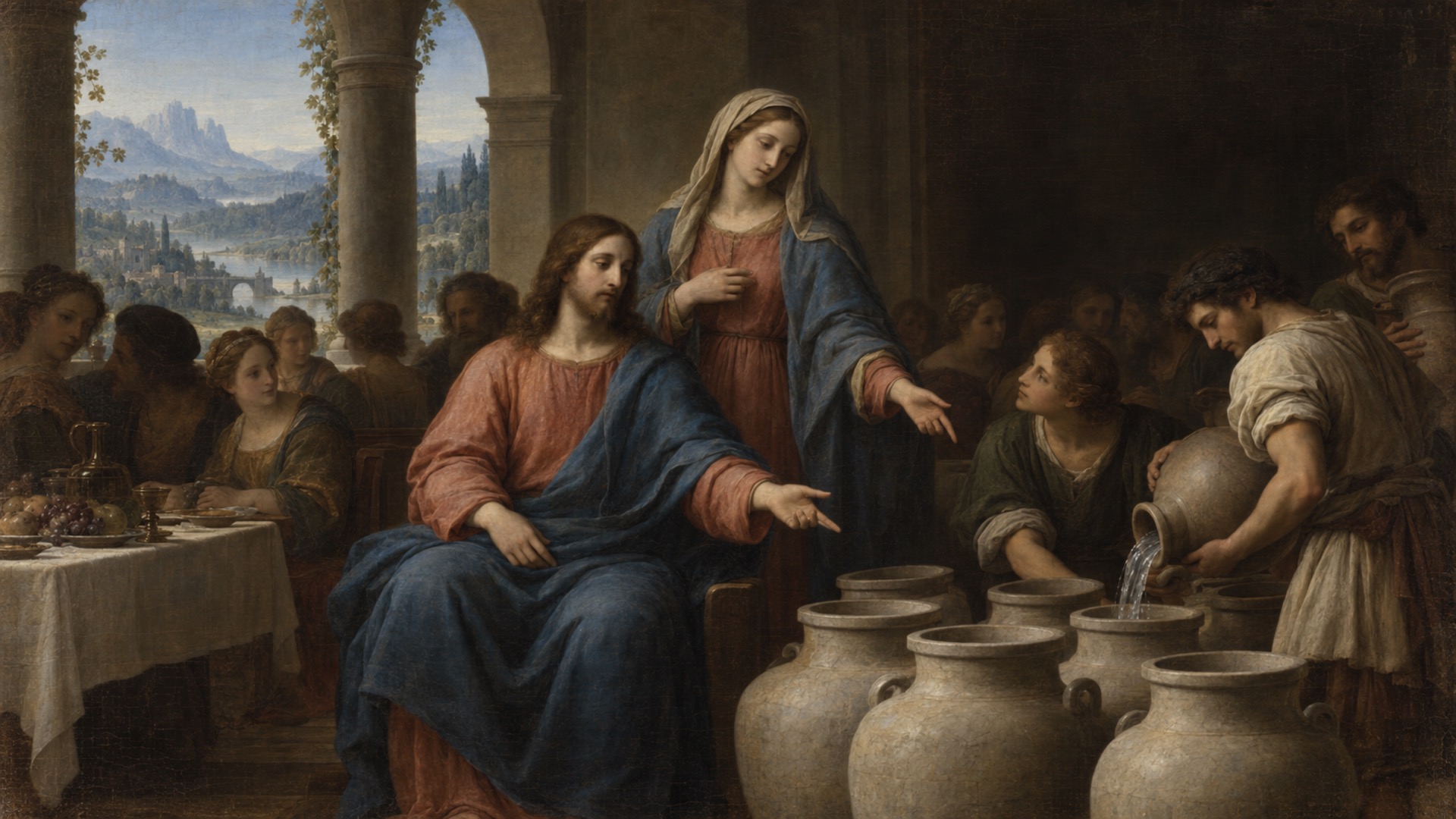
3 When the wine ran out, Jesus’ mother said to him, “They have no wine.”
4 Jesus said to her, “Woman, what does that have to do with you and me? My hour has not yet come.”
5 His mother said to the servants, “Whatever he says to you, do it.”
6 Now there were six water pots of stone set there after the Jews’ way of purifying, containing two or three metretes apiece.
7 Jesus said to them, “Fill the water pots with water.” So they filled them up to the brim.
8 He said to them, “Now draw some out, and take it to the ruler of the feast.” So they took it.
9 When the ruler of the feast tasted the water now become wine, and didn’t know where it came from, but the servants who had drawn the water knew, the ruler of the feast called the bridegroom,
10 and said to him, “Everyone serves the good wine first, and when the guests have drunk freely, then that which is worse. You have kept the good wine until now!”
11 This beginning of his signs Jesus did in Cana of Galilee, and revealed his glory; and his disciples believed in him.
A Quiet Guide to This Passage
- Bring the need to Jesus plainly, without trying to prescribe the miracle.
- Listen for the next faithful instruction even when it seems ordinary.
- Practice obedience before you can see how the final result will emerge.
- Remember that the glory of Jesus is often recognized by people who quietly serve.
Devotional Reflection
The first sign in John’s Gospel happens at a wedding. Jesus enters a household celebration filled with food, conversation, family expectation, and the possibility of embarrassment. His presence at Cana reminds us that divine grace is not limited to visibly religious settings. God meets people in the ordinary fabric of human life.
When the wine runs out, Mary notices the problem and brings it to Jesus. She offers no speech about how he should solve it. She simply says, ‘They have no wine.’ This is a helpful shape for prayer. We can name the need honestly without pretending to understand the timing, method, or wider purpose of Christ.
Jesus’ response points toward his hour, a phrase that will eventually lead to the cross and resurrection. The miracle at Cana cannot be separated from the larger revelation of who he is. He is not merely preventing social embarrassment. He is beginning to reveal the abundance, transformation, and joy associated with God’s saving presence.
Mary then turns to the servants and says, ‘Whatever he says to you, do it.’ She does not promise that his instruction will make immediate sense. She directs their attention away from her and toward him. Trust becomes readiness to respond.
Jesus tells the servants to fill six stone water pots. The task is ordinary and demanding. They must carry enough water to fill large vessels, and John emphasizes that they fill them to the brim. Their obedience creates no wine by its own power, yet it places the available vessels fully within the command of Jesus.
Much of faithful life resembles carrying water. We apologize, prepare, show up, keep a promise, make the call, or complete work that appears too small to address the deeper need. Obedience is not a way to force God’s hand. It is a willingness to offer the next honest action while trusting that Christ can do what our action cannot accomplish.
The servants then draw from the jars and take the contents to the ruler of the feast. This step requires additional trust because they know what they placed in the vessels. The ruler tastes wine of unexpected quality and praises the bridegroom. The public celebration continues, while the servants understand something about the hidden source of the gift.
Those who serve are often among the first to recognize where grace has been at work. They may not receive public attention, but they have watched the ordinary become part of a sign. Their knowledge comes from participating in obedience rather than observing from a comfortable distance.
The generous amount of wine points toward abundance. Jesus does not provide a barely sufficient emergency measure. The sign reveals a kingdom in which God’s grace is not thin, reluctant, or exhausted. The best has arrived in the person of Christ.
This does not mean that every request will be answered in the form we imagine. Mary brings the need to Jesus and leaves the decision with him. Her confidence is not control. It is trust in his character and an instruction to remain attentive to his word.
If you are facing a shortage today, name it plainly. Then ask what faithful obedience looks like before the outcome is visible. The instruction may seem simple, and the work may feel unrelated to the miracle you desire. Christ is able to receive ordinary faithfulness and reveal his glory through it.
Lord Jesus, we bring you the places where our resources have run out. Keep us from panic and from trying to control your answer. Make us attentive to your word and faithful in the ordinary work you place before us. Give us courage to obey before we see the result, and let our lives reveal the generous grace that comes through you. Amen.
New Day Focus shares peaceful Gospel readings, thoughtful Christian devotionals, and prayer for the day ahead.