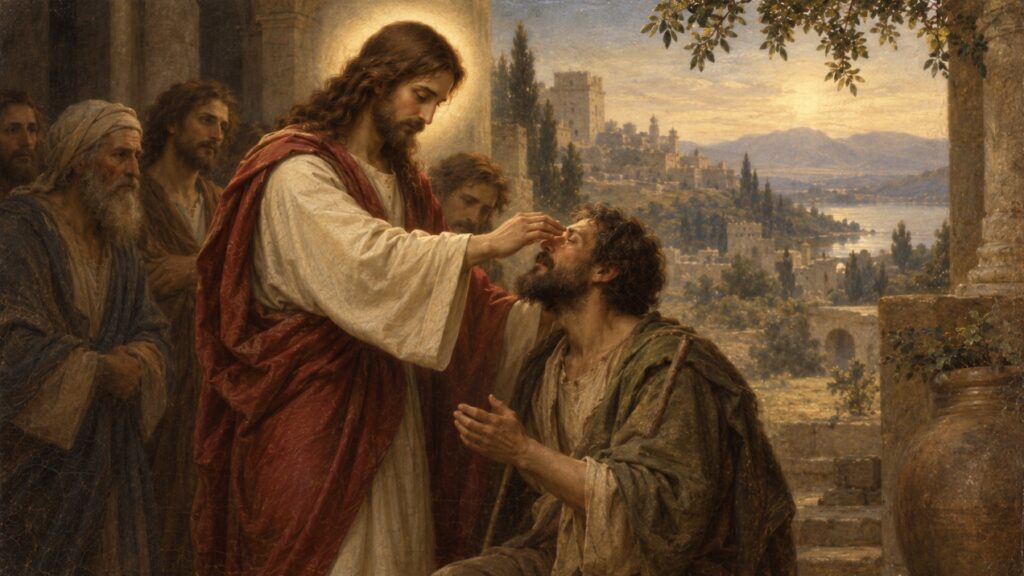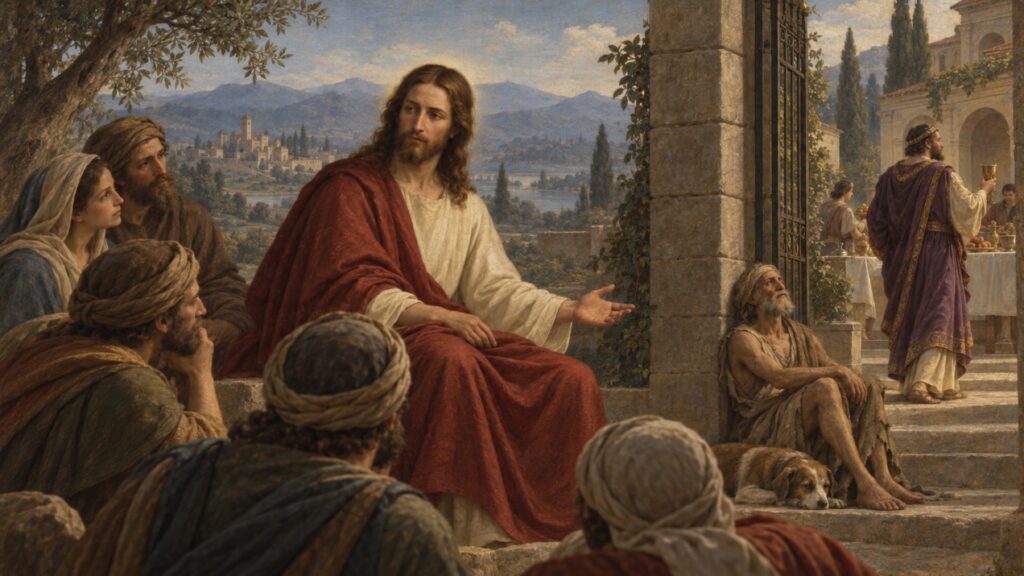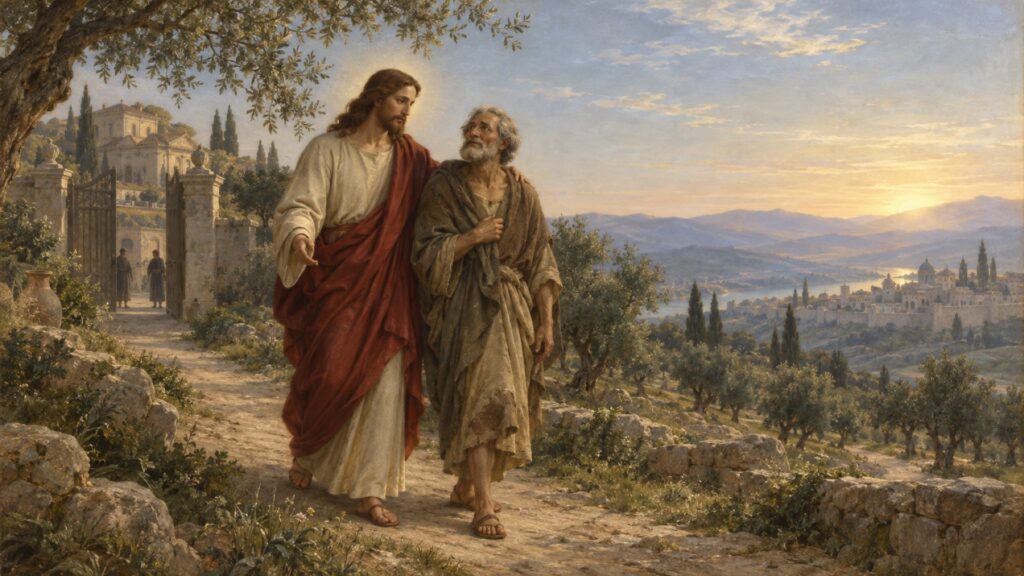
Some things are difficult to release because they have become part of how we feel safe, successful, or worthy. Jesus looks at the rich young man with love and reveals the attachment that keeps him from receiving the freedom he desires.
This reflection follows Matthew 19 through the young man’s sincere question, the sorrow of divided loyalty, the image of a camel and a needle, and the hope found in the God for whom salvation is possible.
“With men this is impossible, but with God all things are possible.”
Matthew 19:26, World English Bible
The Gospel Reading
Matthew 19:16–26. World English Bible, public domain.
16 Behold, one came to him and said, “Good teacher, what good thing shall I do, that I may have eternal life?”
17 He said to him, “Why do you call me good? No one is good but one, that is, God. But if you want to enter into life, keep the commandments.”
18–19 He said to him, “Which ones?” Jesus said, “You shall not murder. You shall not commit adultery. You shall not steal. You shall not offer false testimony. Honor your father and your mother. And, You shall love your neighbor as yourself.”
20 The young man said to him, “All these things I have observed from my youth. What do I still lack?”
21 Jesus said to him, “If you want to be perfect, go, sell what you have, and give to the poor, and you will have treasure in heaven; and come, follow me.”
22 But when the young man heard this, he went away sad, for he was one who had great possessions.
23–24 Jesus said to his disciples, “Most certainly I say to you, a rich man will enter into the Kingdom of Heaven with difficulty. Again I tell you, it is easier for a camel to go through a needle’s eye than for a rich man to enter into God’s Kingdom.”
25 When the disciples heard it, they were exceedingly astonished, saying, “Who then can be saved?”
26 Looking at them, Jesus said, “With men this is impossible, but with God all things are possible.”
A Quiet Guide to This Passage
- Ask what possession, identity, or outcome has become too important to surrender.
- Hear the difficult words of Jesus as an invitation into freedom rather than a demand for self punishment.
- Let generosity become a practical expression of trust in God.
- Rest salvation in God’s grace instead of treating spiritual life as another achievement.
Devotional Reflection
The young man approaches Jesus with an earnest question about eternal life. He is not presented as careless or openly hostile. He has pursued obedience and still senses that something is missing. A life can look ordered from the outside while the heart remains divided around one attachment it cannot imagine releasing.
Jesus identifies the place where obedience has not yet become surrender. Material things are not automatically evil, but wealth can become a source of identity and control so powerful that the invitation of Christ feels like loss rather than life. What we own begins to own us when our peace depends on keeping it untouched.
The man goes away sorrowful because he has great possessions. Jesus does not chase him with a reduced demand designed to preserve the appearance of success. Love respects the truth. Christ allows him to see the choice clearly because discipleship built on concealed conditions would not be freedom.
The attachment could be money, reputation, comfort, control, a relationship, or a future planned so carefully that God is permitted only to bless it. Surrender becomes difficult when the thing is not merely something we have but something we use to answer the question of who we are.
Jesus’ image of a camel passing through the eye of a needle is intentionally impossible. The disciples understand that human achievement cannot solve the problem. Salvation is not the reward for constructing an impressive spiritual record. The impossible image leads directly to the grace of God.
This keeps the passage from becoming an invitation to pride among people who own less. Poverty does not automatically make a heart free, just as wealth does not make a person unreachable. We can cling to very little with enormous fear, or hold much with generosity and open hands. Only God can free the heart from the need to save itself through what it controls.
Generosity is one way grace loosens that grip. Giving does not purchase salvation, but it exposes the illusion that security comes only from accumulation. When we share with someone in need or simplify a desire so another person can flourish, the heart practices trust. The gift becomes a confession that God remains the source of life.
Letting go does not mean treating responsibilities lightly. Providing for a family, planning wisely, and caring for resources can be faithful work. Surrender means that these responsibilities remain under the authority of Christ. We ask not only what we can afford but what love requires.
The final word is not the sorrow of the young man. Jesus says that what is impossible with people is possible with God. The heart that cannot free itself can be transformed by grace. We come with the attachment named honestly and ask God to do what we cannot do alone.
Lord Jesus, reveal what we hold too tightly and meet us without contempt in that place. Give us courage for practical generosity, wisdom for responsible stewardship, and trust that does not depend on controlling every outcome. Let your grace become the security from which we live. Amen.