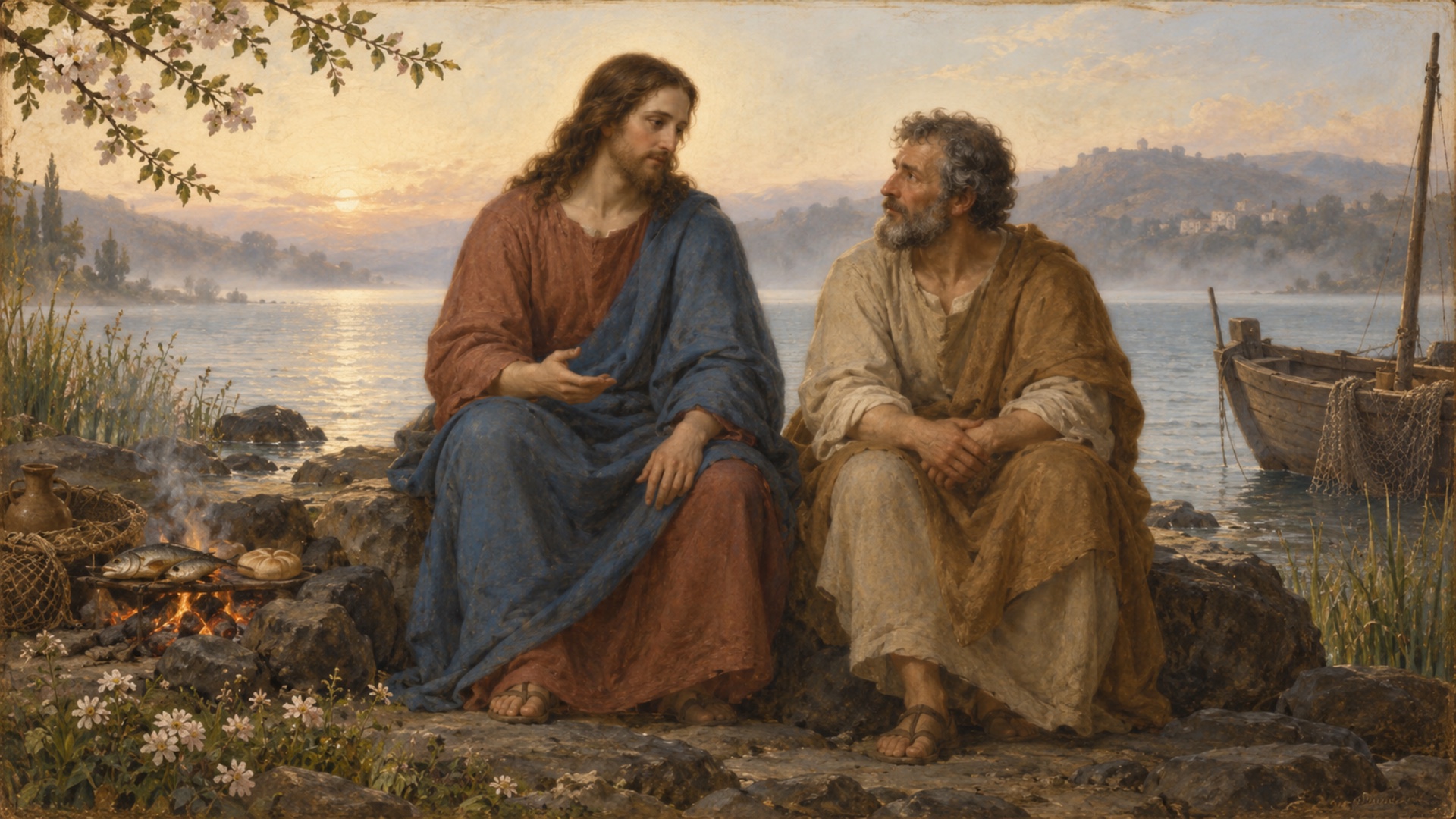
Failure may change the way you see yourself, but it does not place you beyond the restoring grace of Jesus. Beside the sea, the risen Christ meets Peter with truth, mercy, and a renewed call to follow.
This New Day Focus devotional enters John 21:15–19 through the question, “Do you love me?” We reflect on honest confession, the healing of shame, the rebuilding of trust, care for the people Jesus loves, and the possibility of beginning again.
“He said to him, ‘Lord, you know everything. You know that I love you.’”
John 21:17, World English Bible
The Gospel Reading
John 21:15–19. World English Bible, public domain.
15 So when they had eaten their breakfast, Jesus said to Simon Peter, “Simon, son of Jonah, do you love me more than these?”
He said to him, “Yes, Lord; you know that I have affection for you.”
He said to him, “Feed my lambs.”
16 He said to him again a second time, “Simon, son of Jonah, do you love me?”
He said to him, “Yes, Lord; you know that I have affection for you.”
He said to him, “Tend my sheep.”
17 He said to him the third time, “Simon, son of Jonah, do you have affection for me?”
Peter was grieved because he asked him the third time, “Do you have affection for me?” He said to him, “Lord, you know everything. You know that I have affection for you.”
Jesus said to him, “Feed my sheep.
18 Most certainly I tell you, when you were young, you dressed yourself and walked where you wanted to. But when you are old, you will stretch out your hands, and another will dress you and carry you where you don’t want to go.”
19 Now he said this, signifying by what kind of death he would glorify God. When he had said this, he said to him, “Follow me.”
A Quiet Guide to This Passage
- Allow Jesus to meet you in the place where regret has shaped your view of the future.
- Answer him honestly without trying to impress him with promises you cannot prove.
- Receive restoration as a call to love and care for others with humility.
- Follow Christ in the next faithful step instead of waiting to feel completely unafraid.
Extended Devotional Reflection
This extended written reflection follows the same Gospel passage and themes as the video, with additional space for prayerful reading.
That knowledge is why Peter eventually answers, “Lord, you know everything.” He has stopped making grand promises about his own strength. Before the crucifixion, he declared that he would lay down his life for Jesus. By the shore, he appeals to what Jesus knows rather than to what he can prove. Failure has stripped away some of his self confidence, but it has also opened a more honest form of trust. Peter places his imperfect love inside the complete knowledge of Christ.
There is freedom in praying from that same place. You do not need to manage the evidence before coming to Jesus. He knows what you meant to do, what you actually did, and what you still do not understand about yourself. His knowledge reaches beyond the simplified story in which you are either entirely innocent or entirely beyond hope. You can tell the truth because the truth is already held by mercy. Honest confession is not information offered to an unaware God. It is consent to healing in the presence of the one who knows everything.
Jesus asks, “Do you love me?” He does not begin by asking Peter to explain the pressure in the courtyard or identify everyone who contributed to his fear. Those details matter, and compassion understands them, but explanation alone cannot restore the center of discipleship. Jesus brings Peter back to relationship. Love for Christ is not a feeling added to Christian life after more practical concerns have been handled. It is the living center from which obedience, service, endurance, and hope receive their meaning.
The first question includes the words “more than these.” The phrase has been understood in several ways. Jesus may be asking whether Peter loves him more than the other disciples do, whether he loves Jesus more than he loves the familiar work of fishing, or whether his love exceeds his attachment to everything represented by the life around him. The Gospel does not pause to settle the reference. Its effect is to remove love from vague sentiment and place it among real loyalties. Every life gathers around something, and Jesus asks whether Peter’s heart truly belongs to him.
Before the denial, Peter had compared himself confidently with the others. Even if everyone else fell away, he believed he would remain. On the beach, his answer is quieter. He does not claim superior devotion. He says, “Yes, Lord; you know that I have affection for you.” Pain has made him less certain of his own heroism, and that humility becomes part of his restoration. Jesus is not asking for a performance of confidence. He is drawing out a truthful love that can become dependable because it no longer rests on illusion.
This speaks to anyone who thinks faith must always sound certain. There are moments when love for Jesus exists beside grief, confusion, or awareness of weakness. Peter cannot offer the fearless declaration he once made, but he can offer the truth he has. Christ receives that honest answer and gives him responsibility. A humbled love is not useless love. When it has been brought into the light, it can become a steadier foundation than confidence that has never been tested.
Jesus asks the question three times, and Peter is grieved by the third. The repetition clearly echoes the three denials. Each answer meets a place where fear once spoke. Jesus is not cruelly replaying the worst night of Peter’s life. He is allowing Peter to respond differently in the presence of grace. The wound is not ignored, and neither is it reopened without purpose. Christ brings Peter through the memory so that failure will no longer control it from the shadows.
Healing often includes this kind of honest return. We may prefer a restoration that never names what happened, because naming it can feel dangerous. Silence, however, can leave shame in authority. When Jesus returns to Peter’s failure, he changes its meaning. The remembered scene no longer ends with denial and weeping. It now includes the risen Lord, a truthful answer, a renewed calling, and a command to follow. Grace does not erase history. It enters history and creates a future within it.
There may be a memory you have tried to outrun because it seems to prove that you cannot be trusted again. The passage does not promise that every consequence disappears or that damaged relationships are restored immediately. Peter’s forgiveness does not make maturity automatic. It does show that Jesus can address the exact place of failure without reducing a person to it. The question “Do you love me?” opens a door that shame had declared permanently closed.
Peter’s answer is followed each time by a responsibility: feed my lambs, tend my sheep, and feed my sheep. Love for Jesus moves toward care for people who belong to him. Peter is not restored merely so that he can feel better about himself. He is entrusted with service. The disciple who has discovered his own need for mercy is being prepared to shepherd others who will also be vulnerable, inconsistent, and dependent on grace.
This connection between love and care protects service from becoming self promotion. Jesus does not say, “Build your own following so that everyone can see you have recovered.” The sheep remain his. Peter’s role is stewardship under the chief shepherd. Christian leadership is therefore never ownership of people. It is the responsibility to nourish, guide, and protect those whom Christ loves, while remaining accountable to his voice and character.
The command also reveals that restoration can include meaningful responsibility. Shame tells us that the only safe future is permanent withdrawal. Wisdom may require a season of healing, accountability, and rebuilt trust, especially when others have been harmed. The timing and form of responsibility should never be rushed to protect an image. Even so, failure does not automatically mean that God has no further purpose for a repentant life. Jesus can restore service with greater humility, clearer boundaries, and deeper compassion than existed before.
Feeding the sheep begins with receiving nourishment from Christ. Peter cannot give spiritual food by relying on personality or determination. He must remain a disciple even while becoming a shepherd. The same is true whenever we care for children, friends, a church, a family member, or anyone entrusted to us. We need the words of Jesus, the presence of the Spirit, honest community, and rhythms of rest. Service becomes unhealthy when we try to provide from an identity that no longer knows how to receive.
Lambs require gentleness because they are easily frightened and cannot carry what mature sheep can carry. The command to feed Christ’s lambs asks for patience with people who are beginning, wounded, young, or unsure. Strong faith does not handle fragile people roughly. Peter’s own recent collapse should make him slower to condemn weakness in others. The memory of mercy can become tenderness rather than embarrassment when it remains in the hands of Jesus.
Tending the sheep includes more than speaking comforting words. A shepherd watches, guides, protects, and sometimes confronts danger. Care shaped by Christ joins tenderness with truth. It does not control another person in the name of concern, and it does not avoid every difficult conversation in the name of kindness. Peter will need courage that is no longer about proving himself. He will need the courage to remain present for the good of others.
The passage therefore asks a practical question of every believer. If love for Jesus is real, who is affected by it? The answer does not require a public platform. Feeding Christ’s sheep may look like listening carefully to someone who is lonely, teaching a child with patience, carrying a meal, speaking truth without humiliation, or praying faithfully for a person who cannot repay you. Love becomes visible as another life receives care.
This care must stay connected to Jesus or it can turn into resentment. We may serve because we fear disappointing people, need to feel necessary, or want quiet control over outcomes. Those motives eventually exhaust the heart. Jesus brings Peter back to love before giving the command because service is meant to flow from relationship with him. When we remember whose sheep they are, we can care deeply without imagining that we are their savior.
After restoring Peter’s calling, Jesus speaks about the future cost of discipleship. Peter once claimed that he would die for Jesus, and now Jesus tells him that one day his faithfulness will indeed lead where he does not want to go. John explains that this referred to the kind of death by which Peter would glorify God. The words are solemn, but they are not a threat. They show that Peter’s story will not end in the cowardice of the courtyard. Grace will form in him the endurance he could not manufacture for himself.
Jesus does not demand that Peter possess all of that courage on the beach. He gives one command: “Follow me.” The strength required for the distant future will grow through present discipleship. Peter must walk with Christ through the next act of obedience before facing what comes years later. This is merciful because imagined future trials can overwhelm us. Jesus meets us today and gives grace for the step that belongs to today.
We often judge ourselves by asking whether we could endure the hardest possibility we can imagine. Because we cannot feel tomorrow’s strength in advance, we assume we will fail again. Peter’s life reminds us that grace is given within the path, not stored as a feeling before the journey begins. The man who trembled near a charcoal fire would become a faithful witness because the risen Jesus kept forming him. Your present weakness is real, but it does not set a fixed limit on what Christ can develop through years of following.
“Follow me” also returns Peter to his first calling. At the beginning of the Gospel story, Jesus had invited him away from his nets. After resurrection and restoration, the essential invitation remains. Peter does not graduate beyond dependence on Christ. His future ministry, courage, and leadership will remain healthy only as they stay inside the simple posture of a disciple walking behind Jesus.
Beginning again with God does not always require a completely new direction. Sometimes it means returning to the calling beneath the noise, now with greater honesty. Prayer becomes less performative. Service becomes less concerned with recognition. Scripture becomes nourishment rather than material used to appear knowledgeable. The same practices may remain, but grace changes the person who enters them.
Bring love for you back to the center of our lives. Free us from impressive promises that depend on our own strength, and form in us a quieter faithfulness that can endure. Teach us to receive your provision, remain close to your words, and follow when the path is clear only one step at a time. Prepare tomorrow’s courage through today’s obedience.
Show us how to feed the people you have entrusted to our care. Give gentleness for those who are fragile, wisdom for difficult conversations, patience for slow growth, and humility that remembers the sheep belong to you. Protect us from serving for approval or control. Let every act of care rise from fellowship with you and lead another person toward nourishment, safety, and truth.
Be near to anyone who believes failure has ended their usefulness. Provide trustworthy people, practical help, and the time needed for healing. Where consequences remain, give patience to walk through them without despair. Where a door should remain closed for safety, grant acceptance and reveal another faithful way to love. Where restoration is possible, let it develop with honesty and grace.
Thank you that Peter’s denial was not the last word over his life. Because you rose from the dead, our worst moment does not possess final authority. Call us again, Lord Jesus, and help us answer without hiding. We place our past, our love, our weakness, and our future within your complete knowledge. Lead us from this morning into the work of love you have prepared. In your name, Jesus, amen.
As you enter the day, carry the shore with you. The risen Jesus knows what happened, knows what can be healed, and knows who you may yet become through grace. His question is personal, but it is not a trap. It is an invitation back to love, service, and discipleship. Answer him honestly, then hear the words that open the road ahead: “Follow me.”
New Day Focus shares peaceful Gospel readings, thoughtful Christian devotionals, and prayer for the day ahead.