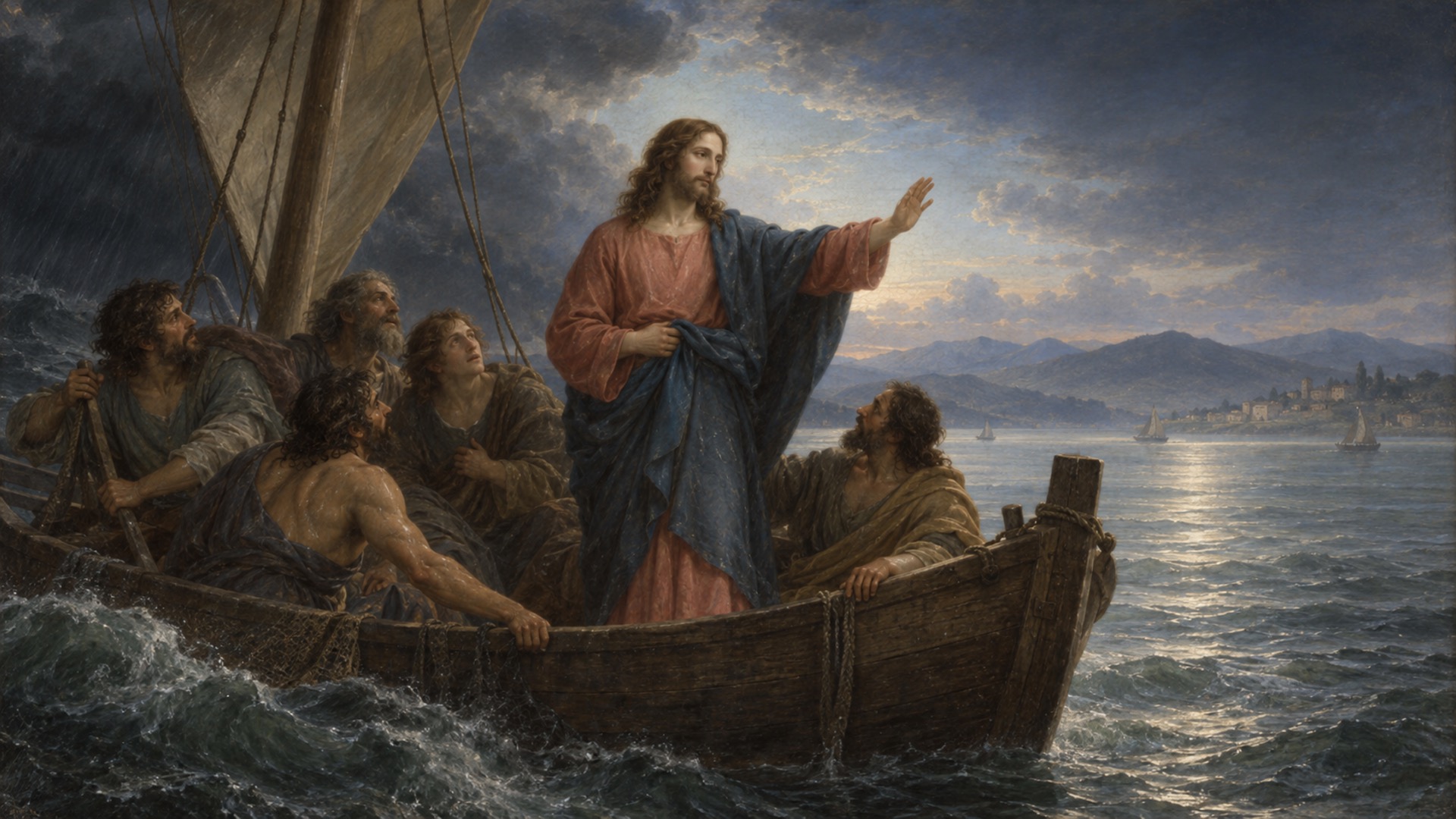
A hard moment can make the presence of Jesus feel strangely distant. In the storm on Galilee, the disciples do not only fear the wind and waves. They wonder whether the sleeping Jesus cares that they are in danger.
This reflection enters Mark 4 through the overwhelmed boat, the disciples’ frightened question, the command that brings a great calm, and the deeper discovery that Jesus is Lord even when his care is difficult to recognize.
“Peace! Be still!”
Mark 4:39, World English Bible
The Gospel Reading
Mark 4:35–41. World English Bible, public domain.
35 On that day, when evening had come, he said to them, “Let’s go over to the other side.”
36 Leaving the multitude, they took him with them, even as he was, in the boat. Other small boats were also with him.
37 A big wind storm arose, and the waves beat into the boat, so much that the boat was already filled.
38 He himself was in the stern, asleep on the cushion; and they woke him up and asked him, “Teacher, don’t you care that we are dying?”
39 He awoke and rebuked the wind, and said to the sea, “Peace! Be still!” The wind ceased and there was a great calm.
40 He said to them, “Why are you so afraid? How is it that you have no faith?”
41 They were greatly afraid and said to one another, “Who then is this, that even the wind and the sea obey him?”
A Quiet Guide to This Passage
- Tell Jesus what fear is making you believe about his care.
- Remember that a storm does not prove you have left the path Christ asked you to take.
- Look for the presence of Jesus before demanding a particular timetable for calm.
- Let the authority of Christ become larger in your imagination than the crisis around you.
Devotional Reflection
The journey begins with a clear instruction from Jesus: ‘Let’s go over to the other side.’ The disciples are not in the storm because they ignored him. They are there because they followed his direction. This detail corrects the painful assumption that hardship always means we have chosen the wrong road or lost God’s favor.
Evening falls as they cross the lake, and a great windstorm rises. Waves strike the boat until it begins filling with water. Several disciples know this lake and understand boats, yet experience does not give them control. The crisis has moved beyond the range of their ordinary skill, which is often where fear becomes most intense.
Jesus is asleep in the stern on a cushion. His rest reveals real human weariness after a day of teaching, but to the frightened disciples his silence feels like absence. They wake him with a question that joins danger to accusation: ‘Teacher, don’t you care that we are dying?’ The storm outside has created a conclusion about the heart of Jesus.
Many prayers in hard seasons carry the same question. We may not say it aloud, but delay can feel like neglect. Unanswered prayer can be interpreted as indifference. The Gospel does not hide the disciples’ accusation, which means we do not have to hide ours. Jesus is strong enough to receive frightened honesty.
He rises, rebukes the wind, and speaks to the sea. ‘Peace! Be still!’ The response is immediate, and the great storm becomes a great calm. Mark presents no struggle between Jesus and the elements. Creation recognizes an authority the disciples are still learning to understand.
Not every storm in our lives ends immediately. This passage is not a promise that faithful prayer will always produce the outcome we prefer on our schedule. It reveals who is present in the boat. The One who commands the sea is not powerless when circumstances remain unsettled. His authority holds even when we are still waiting to see how the story will change.
Jesus then asks why they are afraid and how they have no faith. He is not mocking the reality of the danger. Water was entering the boat. His question reaches the meaning they gave to the danger. Fear had persuaded them that his quietness meant he did not care, even though he had entered the crossing with them.
Faith is not the denial of waves. It is the refusal to let the waves become the final truth about Jesus. We can acknowledge the diagnosis, financial pressure, conflict, or grief without giving that circumstance authority to define God’s character. The cross and resurrection tell us more about his love than the storm is able to tell us.
After the sea becomes calm, the disciples are filled with a different kind of fear. They ask, ‘Who then is this, that even the wind and the sea obey him?’ The miracle does not merely solve a transportation problem. It enlarges their understanding of the person beside them. The deepest revelation is not that storms exist or even that storms end, but that Jesus is greater than they imagined.
Your hardest moment may expose what you believe about his identity. If you think of Jesus only as a helpful teacher, his silence may feel like failure. If he is Lord, then silence cannot be equated with abandonment. His presence remains meaningful before the wind changes, and his promise can hold you when your own strength no longer can.
Return to the boat in prayer today. Name the storm without minimizing it. Name the conclusion fear has attached to it. Then look again at Jesus, not as a distant observer but as the Lord who has entered human vulnerability, carried suffering to the cross, and passed through death into life. The storm is real, but it is not the truest thing in the scene.
Lord Jesus, meet us in the moments when fear questions your care. Help us speak honestly without allowing panic to define your character. Give us wisdom for the work that is ours to do and trust for what remains beyond our control. Whether the calm comes quickly or slowly, keep our hearts anchored in your presence and authority. Amen.
New Day Focus shares peaceful Gospel readings, thoughtful Christian devotionals, and prayer for the day ahead.