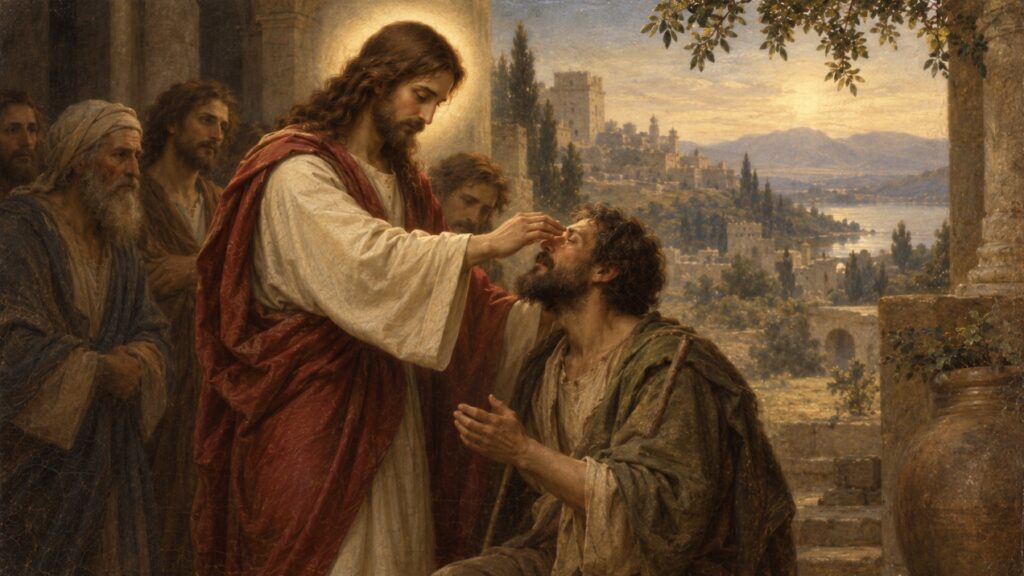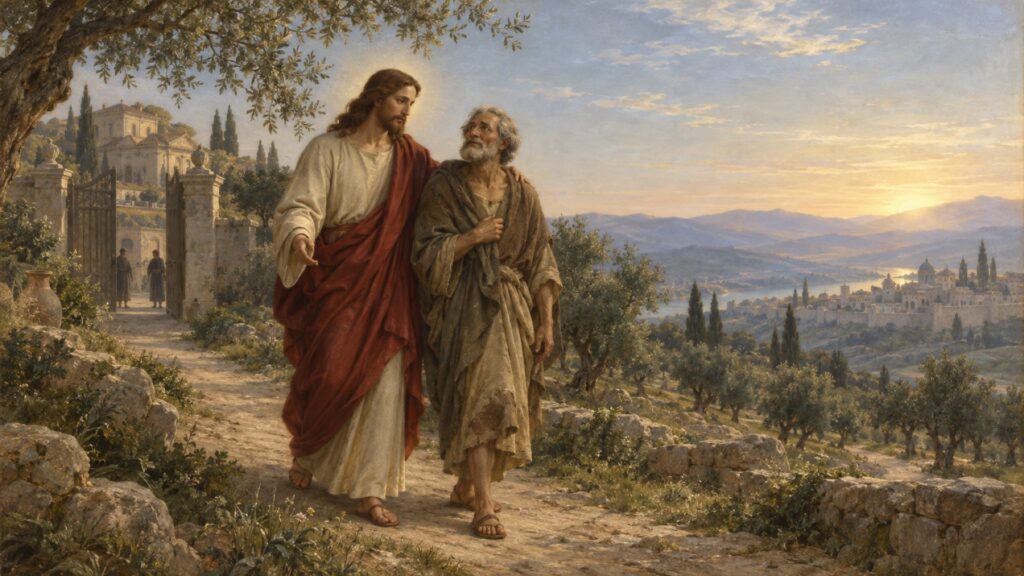
When fear or uncertainty leaves you feeling scattered, Jesus does not watch from a distance. The Good Shepherd knows his own by name, goes before them, and gives his life so they can be safe in his care.
This New Day Focus devotional enters John 10:1–18 through the voice of Christ, the safety of his care, the danger of false shepherds, and the abundant life found by following the one who never abandons his sheep.
“I am the good shepherd. The good shepherd lays down his life for the sheep.”
John 10:11, World English Bible
The Gospel Reading
John 10:1–18. World English Bible, public domain.
1 “Most certainly, I tell you, one who doesn’t enter by the door into the sheep fold, but climbs up some other way, is a thief and a robber.
2 But one who enters in by the door is the shepherd of the sheep.
3 The gatekeeper opens the gate for him, and the sheep listen to his voice. He calls his own sheep by name and leads them out.
4 Whenever he brings out his own sheep, he goes before them; and the sheep follow him, for they know his voice.
5 They will by no means follow a stranger, but will flee from him; for they don’t know the voice of strangers.”
6 Jesus spoke this parable to them, but they didn’t understand what he was telling them.
7 Jesus therefore said to them again, “Most certainly, I tell you, I am the sheep’s door.
8 All who came before me are thieves and robbers, but the sheep didn’t listen to them.
9 I am the door. If anyone enters in by me, he will be saved, and will go in and go out and will find pasture.
10 The thief only comes to steal, kill, and destroy. I came that they may have life, and may have it abundantly.
11 “I am the good shepherd. The good shepherd lays down his life for the sheep.
12 He who is a hired hand, and not a shepherd, who doesn’t own the sheep, sees the wolf coming, leaves the sheep, and flees. The wolf snatches the sheep and scatters them.
13 The hired hand flees because he is a hired hand and doesn’t care for the sheep.
14 I am the good shepherd. I know my own, and I’m known by my own;
15 even as the Father knows me, and I know the Father. I lay down my life for the sheep.
16 I have other sheep which are not of this fold. I must bring them also, and they will hear my voice. They will become one flock with one shepherd.
17 Therefore the Father loves me, because I lay down my life, that I may take it again.
18 No one takes it away from me, but I lay it down by myself. I have power to lay it down, and I have power to take it again. I received this commandment from my Father.”
A Quiet Guide to This Passage
- Listen for the voice of Jesus through the words and character revealed in the Gospels.
- Remember that being known by Christ is a source of safety, not scrutiny or shame.
- Test competing voices by whether they lead toward truth, love, freedom, and life.
- Follow the Shepherd one faithful step at a time when the whole path is not yet visible.
Extended Devotional Reflection
This extended written reflection follows the same Gospel passage and themes as the video, with additional space for prayerful reading.
When You Feel Lost or Unprotected
There are seasons when you can be surrounded by familiar people and still feel lost. You may know where you are going on a map while wondering where your life is going, or you may carry responsibilities for everyone else while quietly wishing someone would notice how tired and unprotected you feel. Into that vulnerable place, Jesus does not offer an impersonal system. He describes himself as the shepherd who knows his own sheep by name, goes before them, and refuses to abandon them when danger comes. His care is not distant supervision. It is personal, costly, and strong enough to lead you home.
Welcome to New Day Focus. Today we are listening to John chapter 10, where Jesus calls himself the door of the sheep and the good shepherd. These images are gentle, but they are not sentimental. The passage includes thieves, strangers, wolves, and hired workers who run when the cost becomes real. Jesus speaks into a world where voices compete for trust and where vulnerable lives can be used for another person’s gain. He wants us to recognize the difference between a voice that takes and the voice of the one who gives his life.
Our reading is John chapter 10, verses 1 through 18, from the World English Bible. “Most certainly, I tell you, one who doesn’t enter by the door into the sheep fold, but climbs up some other way, is a thief and a robber. But one who enters in by the door is the shepherd of the sheep. The gatekeeper opens the gate for him, and the sheep listen to his voice. He calls his own sheep by name and leads them out. Whenever he brings out his own sheep, he goes before them; and the sheep follow him, for they know his voice. They will by no means follow a stranger, but will flee from him; for they don’t know the voice of strangers.”
“Jesus spoke this parable to them, but they didn’t understand what he was telling them. Jesus therefore said to them again, ‘Most certainly, I tell you, I am the sheep’s door. All who came before me are thieves and robbers, but the sheep didn’t listen to them. I am the door. If anyone enters in by me, he will be saved, and will go in and go out and will find pasture. The thief only comes to steal, kill, and destroy. I came that they may have life, and may have it abundantly.’”
“‘I am the good shepherd. The good shepherd lays down his life for the sheep. He who is a hired hand, and not a shepherd, who doesn’t own the sheep, sees the wolf coming, leaves the sheep, and flees. The wolf snatches the sheep and scatters them. The hired hand flees because he is a hired hand and doesn’t care for the sheep. I am the good shepherd. I know my own, and I’m known by my own; even as the Father knows me, and I know the Father. I lay down my life for the sheep.’”
“‘I have other sheep which are not of this fold. I must bring them also, and they will hear my voice. They will become one flock with one shepherd. Therefore the Father loves me, because I lay down my life, that I may take it again. No one takes it away from me, but I lay it down by myself. I have power to lay it down, and I have power to take it again. I received this commandment from my Father.’”
The first comfort in this passage is also its first challenge. Jesus says that his sheep listen to his voice. We live among many voices, and some of them speak so constantly that we stop noticing their influence. Fear tells us to prepare for every possible loss. Shame tells us that our worst moment is our truest name. Ambition tells us that worth must be proven through achievement, while resentment insists that peace can come only after someone else pays. These voices often sound urgent because urgency discourages discernment. Jesus speaks with authority, yet his voice leads toward truth, freedom, and life.
Recognizing his voice is not a mysterious talent reserved for unusually spiritual people. We learn it by remaining close to the words, character, and actions of Jesus in the Gospels. His voice will not flatter our pride or invite us to treat another person as less valuable. It will not excuse dishonesty simply because the outcome seems useful. The shepherd who lays down his life will lead us toward costly love, honest repentance, mercy joined with truth, and trust in the Father. When an inner message contradicts that character, it should not receive our obedience merely because it arrives with strong emotion.
Sheep become familiar with a shepherd through repeated care. In the same way, our ability to recognize Christ grows through attention that is steady rather than dramatic. We read a passage slowly enough to hear what it actually says. We bring our decisions into prayer. We listen within the community of believers and test what we believe we have heard against Scripture. Over time, familiar truth becomes easier to distinguish from the noise that borrows spiritual language. Discernment develops through relationship, and relationship develops as we keep returning to the one who has already come near.
Jesus says that the shepherd calls his own sheep by name. In the ancient world of the passage, a shepherd could know the individual animals in a flock through their habits, markings, and sounds. Jesus uses that ordinary knowledge to reveal something extraordinary about his care. You are not an anonymous life hidden inside a crowd. He knows the history behind your reactions, the losses you rarely mention, the hopes you are afraid to say aloud, and the questions that have not found words. His knowledge is complete without becoming cold. The shepherd knows his own because they belong to him in love.
Being known can feel frightening when we have learned to protect ourselves through appearance. We manage what other people see because rejection has taught us to be cautious. We may even carry that habit into prayer, presenting God with a cleaned and shortened version of the truth. The words of Jesus invite us out of that exhausting performance. The one who knows your name already knows the room you keep locked. He does not uncover it for entertainment or shame. He enters as a healer who understands what has been hidden and can lead you toward wholeness.
The shepherd also leads the sheep out. The fold is a place of safety, but it is not the final destination. Pasture lies beyond the gate, which means the shepherd’s care includes movement. Sometimes we ask God to make us secure while remaining exactly where we are. Jesus may answer by leading us from a familiar pattern that has become too small, from a habit that once felt protective, or from a version of ourselves built around fear. His leadership does not always preserve comfort, but it remains faithful to life.
Notice that Jesus goes before the sheep. He does not stand at a distance and point toward a road he refuses to travel. The Gospel shows him entering human weakness, grief, temptation, rejection, and death. He knows the terrain from within our condition. When the path becomes steep or uncertain, Christ is not asking you to walk where he has no understanding. He has gone ahead, and his presence changes the meaning of the road even when it does not immediately change the landscape.
This can steady us when guidance feels incomplete. We often want the whole route before taking the first step. We would like to know where every decision will lead and how every risk will be resolved. The shepherd usually gives enough light for faithful movement rather than total control. A sheep follows the person in front of it. For us, that may mean making the next honest choice, keeping the next promise, asking for needed help, or releasing a plan that has become an idol. Trust grows as we discover that Christ remains present beyond the edge of what we can predict.
Jesus then identifies himself as the door. The image changes, but the meaning becomes even more focused. He is not merely a guide among many possible guides. He is the entrance into salvation, freedom, and pasture. Christian faith therefore rests on more than admiration for the moral vision of Jesus. We come through him. We receive life from him. We trust that his death and resurrection open a way to the Father which we could not build through effort or goodness of our own.
A door creates both welcome and protection. Through Christ, we are invited into belonging, and through Christ, we are guarded from what would consume us. His protection does not mean believers never suffer. The presence of the wolf in the passage keeps us from making that promise. It means that suffering, sin, accusation, and death do not have the final claim. The shepherd’s authority reaches beyond the threat. Even when we pass through a dark valley, we remain his, and the one who owns the sheep does not calculate whether they are worth the trouble.
Jesus says that those who enter through him will go in and go out and find pasture. There is a sense of peaceful freedom in those words. Fear makes the world feel narrow because every direction appears dangerous. Control responds by closing more doors until life itself becomes confined. The shepherd offers security that allows movement. We can rest without surrendering our calling, and we can move without believing that everything depends on us. The presence of Christ becomes our safety as we enter the ordinary responsibilities of the day.
Pasture suggests nourishment suited to real need. Much of modern life keeps us consuming while leaving us spiritually hungry. We move from one image, opinion, purchase, or notification to the next, yet the heart remains thin because stimulation is not the same as nourishment. Jesus does not shame us for hunger. He leads us toward what can sustain us. His words, the grace of God, honest worship, meaningful work, loving community, quiet prayer, and service offered without performance become places where the soul can receive rather than merely react.
The promise of abundant life is often misunderstood. Jesus is not guaranteeing luxury, constant ease, or escape from limitation. He describes abundance beside a shepherd who will lay down his life, which means the life he gives carries the shape of sacrificial love. Abundance is life restored to its true center in God. It includes peace that can exist within uncertainty, purpose that is not canceled by obscurity, and love that remains generous without being naive. It allows gratitude to grow in ordinary places because life is no longer measured only by what can be accumulated.
The contrast is severe because Jesus wants his listeners to see clearly. The thief comes to steal, kill, and destroy, while Christ comes to give life. Not every influence that promises freedom leads toward it. Some patterns first appear to offer relief but gradually take away our capacity to live honestly. Addiction promises comfort and narrows the world. Envy promises motivation and steals gratitude. Contempt promises strength and destroys tenderness. Endless comparison promises direction while erasing the particular life God has entrusted to us. The fruit reveals the nature of the voice.
Discernment therefore includes asking what a voice produces over time. Does it lead toward love of God and neighbor, or does it make you increasingly isolated and suspicious? Does it make room for truth and responsibility, or does it require secrecy and blame? Does it deepen humility, or does it place you above correction? A deceptive voice may borrow religious words, but it cannot reproduce the character of the good shepherd. Christ leads with holiness and compassion together, and neither is sacrificed to make the other more convenient.
The center of the passage arrives when Jesus says, “I am the good shepherd. The good shepherd lays down his life for the sheep.” His goodness is demonstrated through what he is willing to give. A hired hand may appear faithful while conditions are safe, but danger reveals the limits of his commitment. Jesus does not leave when care becomes costly. The cross is already present in his words. He will place himself between the flock and destruction, not because human beings have made themselves valuable enough, but because self giving love is his character.
This changes how we understand the cross. Jesus says that no one takes his life from him. He lays it down by himself, with authority to take it again. His death is not a tragic interruption that defeats his mission. It is the chosen act through which the shepherd rescues the sheep, and the resurrection reveals that death cannot hold the life he gives. Christian hope is not founded on the idea that danger is unreal. It is founded on the risen Christ who has entered danger and overcome its final power.
When you feel unprotected, it may help to remember that the care of Jesus has already passed the test of cost. We sometimes wonder whether someone will remain when our need becomes inconvenient. Human relationships can fail in precisely that place, and those failures affect the way we imagine God. Jesus does not ask us to trust a vague claim of concern. He points toward the life he freely lays down. The cross says that he has not confused love with easy affection. He knows what faithfulness costs, and he does not turn away.
The hired hand runs because the sheep do not belong to him. His connection is temporary and conditional. Jesus speaks differently when he says, “I know my own, and I’m known by my own.” Belonging is woven into his care. For anyone who has felt disposable, this is sacred ground. Your value to Christ is not based on usefulness, visibility, youth, success, or the ability to meet another person’s expectations. You belong to the shepherd who has made you his own through grace.
Belonging to Christ does not erase our need for healthy human relationships. The shepherd forms one flock, which means isolated faith is not the goal. We need people who can remind us of truth when pain makes the stranger’s voice sound convincing. We need worship, friendship, correction, practical care, and the humility to receive help. Community cannot replace Jesus, but it can become one of the ways his shepherding care reaches us. The flock is safest when it remains near the shepherd and when its members do not pretend they have no need of one another.
Jesus speaks of other sheep who are not yet of this fold, and he says that he must bring them also. His vision is wider than the boundaries his first listeners might have imagined. The one flock will be gathered through his voice rather than through human sameness. This gives the church a posture of welcome. We do not decide who is beyond the reach of grace. We bear witness to Christ, make room for those he is drawing, and remember that every person enters through the same mercy.
One flock does not mean one personality, culture, or story. Christ creates unity without flattening the people he gathers. The sheep know one shepherd, and that shared allegiance becomes deeper than the differences which might otherwise divide them. This challenges communities that organize belonging around preference, status, politics, or background. The good shepherd does not gather a private circle designed to confirm us. He creates a people in whom his reconciling love becomes visible.
There may be a particular stranger’s voice pressing on you today. Perhaps it says that your future is already ruined, that asking for help would expose weakness, or that you must keep everyone pleased in order to remain loved. Bring that sentence into the light and compare it with the voice of Jesus. The shepherd knows you by name, goes before you, gives himself for you, and leads toward life. His voice may correct you, but correction in his hands serves restoration. Shame declares a closed identity, while Christ names what is true and opens a path forward.
It is possible to be physically safe and spiritually scattered. Our attention can be pulled in so many directions that we no longer know what deserves trust. The answer is not always to make a dramatic change. Often it begins by becoming quiet enough to hear again. A short daily return to the Gospel can reorient the heart. Read until one sentence becomes clear, carry it into the day, and let your next decision answer it. Familiarity with the shepherd’s voice grows through faithful listening.
If you are making a difficult decision, ask where the path reflects the character of Christ. Wise counsel and practical facts matter, and they should not be ignored in the name of spirituality. Within that careful process, notice which option depends on dishonesty, manipulation, or fear. The shepherd will not lead you through a door that requires you to become less truthful. His path may include sacrifice, but it will not ask you to worship success at the cost of your soul.
If you are grieving, the image of the shepherd can hold tenderness without forcing quick resolution. Grief can make familiar places feel strange because someone or something woven into daily life is gone. Jesus does not rush the mourning sheep. He knows the landscape of loss, and his own tears at the tomb of Lazarus show that divine love does not stand above human sorrow. Following him through grief may mean accepting the care available today while trusting that he can lead you when you cannot imagine the next season.
If you are exhausted from caring for others, remember that you are also a sheep before you are anyone’s helper. You cannot become the good shepherd for every person you love. That place belongs to Jesus. Responsible care sometimes includes limits, rest, and the admission that another life cannot be controlled. You can act with compassion while entrusting what exceeds your reach to Christ. The shepherd’s presence frees love from the impossible burden of being someone else’s savior.
If you have wandered through your own choices, the passage still offers a door. Jesus does not say that only those who never became confused may enter. Salvation is given to those who come through him. Repentance is the honest turn toward the voice that calls us back. It may involve confession, repair, treatment, accountability, or the ending of a destructive pattern. Grace does not make those steps unnecessary. It makes them possible without surrendering to despair.
The shepherd’s authority is gentle, but it is not weak. Jesus has power to lay down his life and power to take it again. The risen shepherd can confront what threatens the flock. We may not see immediate resolution, yet we do not face darkness with only our own endurance. Prayer becomes an act of placing fear beneath the authority of Christ. We name what is real, ask for protection and wisdom, and refuse to grant the threat a greater voice than the one who has conquered death.
Abundant life can begin in very small acts of trust. You may step outside and receive the morning as a gift rather than another demand. You may speak honestly with someone safe, prepare a simple meal with gratitude, or turn off the noise long enough to pray. None of these actions earns the shepherd’s care. They are ways of receiving the pasture he provides. Life becomes abundant as presence replaces constant escape and as grace teaches us to inhabit the day God has actually given.
The path ahead may still bend beyond sight, yet Jesus remains before us there. We do not follow because every question has been answered. We follow because we have come to know the character of the one who leads. His wounds reveal his love, and his resurrection reveals his authority. The unknown future is not empty when the shepherd has entered it first.
Before we pray, allow one phrase from the passage to settle in your heart: “He calls his own sheep by name and leads them out.” Place your own name within that promise. Christ sees the particular person you are, not the polished version you think you should become before approaching him. Listen for his invitation toward the next place of truth, rest, courage, or repentance. You do not have to force the entire journey into this moment. You can follow the voice that gives life through the next faithful step.
Perhaps the most peaceful response today is simply to stop competing with the shepherd. You do not need to see farther than he sees, carry more than he gives you, or prove that you can cross the valley without help. Faith is not the performance of independence. It is the willing rest of a life placed under trustworthy care. Let the pressure to manage every outcome loosen for a moment, and remember that your future remains within the sight of Jesus even where it disappears from yours.
Let us pray. Lord Jesus, good shepherd, meet us where we feel lost, exposed, or uncertain. Quiet the voices that feed fear, shame, pride, and despair, and teach us to recognize your voice through the truth of Scripture and the steady character of your love. Thank you for knowing us by name without turning away from anything you see. Give us courage to be honest in your presence and to receive the mercy we cannot earn.
Lead us through the door of your salvation and into the life you desire for us. Where we have become confined by fear, guide us into faithful freedom. Where we are spiritually hungry, bring us to nourishing truth and loving community. Where we have wandered, call us back with conviction that restores rather than shame that destroys. Help us trust the path before us even when we can see only the next step.
Protect those who feel vulnerable today. Be near to the grieving, the lonely, the exhausted caregiver, the person facing a difficult decision, and the one who wonders whether anyone will remain when the cost becomes high. Surround them with wise and compassionate people. Give practical provision where it is needed, clear boundaries where danger is present, and deep assurance that they are not disposable in your sight.
Form your church into one flock beneath your care. Free us from the pride that narrows welcome and from the fear that treats difference as a threat. Make us attentive to people who stand at the edge, and let our communities reflect your truth, safety, humility, and grace. Keep every leader close to your voice so that no influence which steals or scatters is mistaken for your authority.
Thank you for laying down your life freely and for taking it up again. Because you live, teach us to face the unknown without giving it the final word. Help us receive today as a place where abundant life can grow through love, gratitude, obedience, and rest. Go before us through every landscape ahead, and keep our hearts near enough to hear when you call. We place ourselves and those we love into your faithful care. In your name, Jesus, amen.
As you move into the day, remember that the good shepherd is not watching you from a distant hill. He knows your name, he has given himself for you, and he is already present on the path ahead. You may not know every turn, but you can know the voice that leads toward life. Let that voice be stronger than fear today, and take the next faithful step with the quiet confidence that you do not walk alone.
New Day Focus shares peaceful Gospel readings, thoughtful Christian devotionals, and prayer for the day ahead.