When the need before you is far greater than what you can provide, Jesus does not begin by shaming your limitations. He receives what is honestly placed in his hands and reveals that scarcity is not the end of the story.
This New Day Focus devotional enters John 6:1–15 through the hunger of the crowd, the questions Jesus asks his disciples, the small offering of five loaves and two fish, and the abundance that follows when a limited gift is entrusted to Christ.
“Jesus took the loaves, and having given thanks, he distributed to the disciples.”
John 6:11, World English Bible
The Gospel Reading
John 6:1–15. World English Bible, public domain.
1 After these things, Jesus went away to the other side of the sea of Galilee, which is also called the Sea of Tiberias.
2 A great multitude followed him, because they saw his signs which he did on those who were sick.
3 Jesus went up into the mountain, and he sat there with his disciples.
4 Now the Passover, the feast of the Jews, was at hand.
5 Jesus therefore, lifting up his eyes and seeing that a great multitude was coming to him, said to Philip, “Where are we to buy bread, that these may eat?”
6 He said this to test him, for he himself knew what he would do.
7 Philip answered him, “Two hundred denarii worth of bread is not sufficient for them, that every one of them may receive a little.”
8 One of his disciples, Andrew, Simon Peter’s brother, said to him,
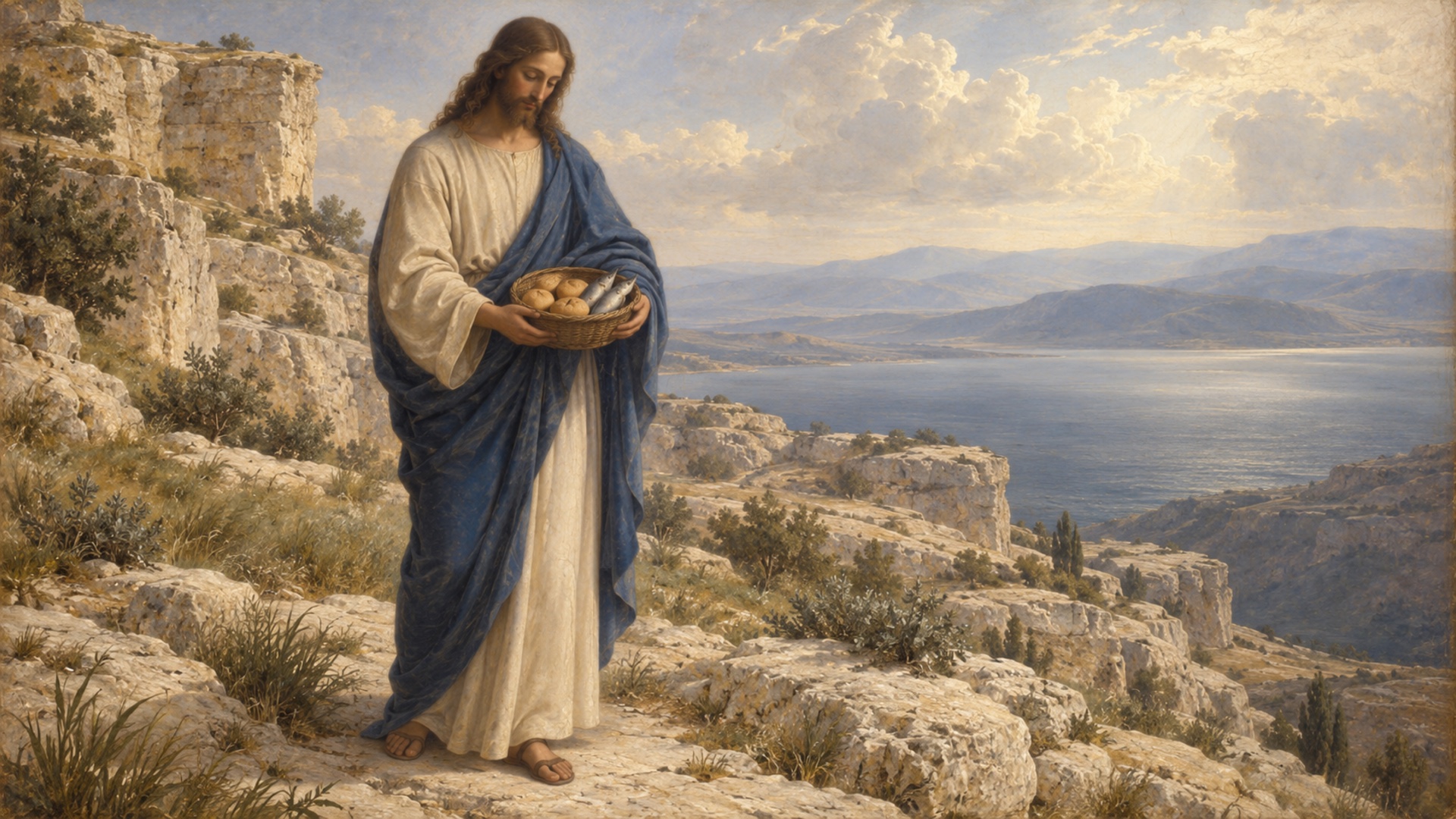
9 “There is a boy here who has five barley loaves and two fish, but what are these among so many?”
10 Jesus said, “Have the people sit down.” Now there was much grass in that place. So the men sat down, in number about five thousand.
11 Jesus took the loaves, and having given thanks, he distributed to the disciples, and the disciples to those who were sitting down, likewise also of the fish as much as they desired.
12 When they were filled, he said to his disciples, “Gather up the broken pieces which are left over, that nothing be lost.”
13 So they gathered them up, and filled twelve baskets with broken pieces from the five barley loaves, which were left over by those who had eaten.
14 When therefore the people saw the sign which Jesus did, they said, “This is truly the prophet who comes into the world.”
15 Jesus therefore, perceiving that they were about to come and take him by force to make him king, withdrew again to the mountain by himself.
A Quiet Guide to This Passage
- Bring your real limitations to Jesus instead of hiding them behind fear or comparison.
- Notice the small resources already present before assuming that nothing can be done.
- Give thanks without pretending the need is small, trusting that Christ sees the whole situation.
- Gather what remains and treat every provision as something worthy of faithful stewardship.
Extended Devotional Reflection
This extended written reflection follows the same Gospel passage and themes as the video, with additional space for prayerful reading.
The story begins with movement. Jesus crosses the sea, the crowd follows, and he climbs the mountain with his disciples. Then he looks up and sees the multitude coming. The need has not yet been spoken, but Jesus recognizes it. This is one of the first comforts in the passage. Before anyone organizes a request or explains the problem, Christ sees the people and understands what they will need.
When we feel overwhelmed, it can seem as though the burden became visible only when we noticed it. Anxiety tells us that if we do not hold every detail in awareness, no one will. Jesus sees before Philip calculates. He is not surprised by the scale of the crowd, the distance from available food, or the lateness that will eventually come. The problem enters the disciples’ attention after it has already been held within his.
This does not make practical questions unnecessary. Jesus asks, “Where are we to buy bread, that these may eat?” He brings Philip into the situation. Faith is not passive avoidance dressed in religious language. It looks honestly at need, considers resources, and accepts responsibility for the next faithful action. The difference is that the calculation happens in the presence of Jesus rather than in a world where everything depends on human capacity.
John tells us that Jesus asked the question to test Philip because he already knew what he would do. A test in Scripture often reveals and develops what is within a person. Jesus is not gathering information. He is helping Philip discover the limits of the framework he instinctively uses. Philip sees the crowd, estimates the cost, and concludes that even a large amount of money would provide only a little for each person.
His calculation is probably accurate. Nothing in the passage suggests that Philip is careless with numbers. The problem is not arithmetic. The problem appears when arithmetic becomes the whole horizon of possibility. We often make the same move. We assess energy, time, money, experience, influence, or opportunity, and the conclusion seems final because the figures are real. Jesus does not ask us to falsify them. He asks us to remember that they are not the only reality present.
There is wisdom in knowing what we have and what we lack. Budgets matter, limits matter, and responsible planning matters. Faith does not promise that every expense will disappear or that every project should proceed despite inadequate resources. The feeding of the crowd is a sign chosen by Jesus, not a formula for forcing God to support any plan we prefer. Its invitation is humbler. We bring the true need and the true limitation to Christ, then remain open to direction that our first calculation could not produce.
Andrew enters the story with a small possibility. He has found a boy carrying five barley loaves and two fish. Barley bread was ordinary food, associated with people of modest means. The meal is not impressive, and Andrew knows it. He presents the offering and questions its significance in the same breath. His uncertainty does not prevent him from bringing it to Jesus.
That movement is worth noticing. Faith can act before confidence feels complete. Andrew does not declare that he has solved the problem. He simply places the available resource within the conversation. Many meaningful acts of service begin this way. Someone offers a skill, an hour, a meal, a room, a ride, a prayer, or a small gift without knowing how far it can reach. The offering remains limited, but it is no longer hidden.
The boy is not named, and John gives us no speech from him. We only know that his food becomes available. Whatever the exact details of that exchange, the image is beautiful. A child’s ordinary meal becomes part of a sign remembered across centuries. The value of the offering cannot be measured by its size before it reaches the hands of Jesus.
We may hold back what we have because comparison makes it seem embarrassing. Someone else has more training, more money, a larger platform, greater energy, or a stronger voice. We imagine that only the impressive contribution is worth offering. The loaves and fish challenge that assumption. Jesus does not despise what is small. He receives it without mocking the person who brings it.
This does not mean every small effort will become publicly visible or produce an outcome we can measure. The point is not that faith guarantees spectacular multiplication of every personal project. The point is that Christ determines the usefulness of what is entrusted to him. Obedience can matter even when the result remains hidden. The boy could not see in advance how his lunch would become nourishment for a multitude.
Jesus tells the people to sit down, and John adds that there was much grass in that place. Order enters the scene before provision becomes visible. The crowd rests on the ground while the available food still appears inadequate. Sitting down requires a small act of trust. They stop moving, searching, and pressing forward long enough to receive.
We sometimes remain in anxious motion because stopping would force us to feel how little control we have. We send another message, search for another answer, or adjust the plan once more. Responsible effort has a place, but there is also a moment to sit down before Christ. Receptivity is not laziness. It is the recognition that provision must sometimes be received rather than produced.
Jesus takes the loaves and gives thanks. Gratitude appears before multiplication is described. He does not give thanks because the amount looks sufficient. He receives what is present as a gift from the Father. This is not denial of the crowd. It is a truthful acknowledgment that scarcity does not erase goodness.
Gratitude can change the spiritual atmosphere of limitation. It does not pretend that five loaves are enough for thousands by themselves. It prevents lack from becoming the only thing we can see. We can thank God for a person who helps, a skill that remains, a small amount of time, a meal on the table, or strength for the next step while still asking for what is needed. Gratitude and honest petition belong together.
The bread is distributed, and everyone receives as much as desired. John moves from insufficiency to satisfaction without explaining the mechanics of the miracle. The mystery remains with Jesus. The disciples participate by distributing what he provides, but they are not the source. Their hands carry the gift without creating it.
This is a healthy picture of ministry and service. We are called to share what Christ supplies, not to become an endless source within ourselves. When we forget this, helping others can turn into exhaustion, control, or quiet resentment. We begin to believe that every need is ours to solve. Jesus involves the disciples while keeping provision centered in him.
For caregivers, parents, leaders, and people who are often asked for help, this distinction matters deeply. Love can require sacrifice, planning, and sustained presence. It also requires humility about limits. You are a participant in the care of God, not the entire supply. Asking others to help, setting boundaries, and returning to Christ for nourishment can be acts of faithful service rather than failures of compassion.
The crowd is filled. The word suggests more than a symbolic taste. Jesus does not divide the meal into portions so small that everyone leaves just as hungry. His provision answers the need before him. The abundance points beyond bread toward his identity, which the rest of John chapter 6 will unfold. The giver is greater than the gift.
This matters because we can seek Jesus mainly for the outcome we want. The crowd later follows him because they ate and were filled. Bread is good, healing is good, and practical provision is worthy of prayer. Yet every gift is meant to reveal the one who gives it. If we receive help without coming to know Christ, we have seen the sign without following where it points.
Jesus is not a tool for securing a more manageable life. He is the Son who reveals the Father and gives eternal life. Sometimes his provision comes in a form we recognize immediately. At other times, he gives endurance, wisdom, community, correction, or a changed direction rather than the outcome we expected. Trust seeks his presence as well as his gifts.
After everyone has eaten, Jesus tells the disciples to gather the broken pieces so that nothing will be lost. Twelve baskets remain. The fragments are not treated as disposable simply because the moment has become abundant. Divine generosity does not encourage waste. The leftovers are gathered with care.
Form gratitude within us before outcomes are clear. Help us recognize present grace while we continue to ask for needed provision. Teach us when to act, when to sit down, when to seek help, and when to release an outcome into your hands. Let our service flow from what you supply rather than from fear, pride, or the need to be indispensable.
Care for those facing hunger, financial pressure, caregiving strain, illness, or needs that feel impossible today. Provide through wise decisions, generous communities, practical assistance, and unexpected opportunities. Protect the vulnerable from promises that exploit their desperation. Make your church attentive to real hunger and willing to share with dignity.
Gather the fragments of our lives with the same care shown in this passage. Where disappointment has altered our plans, reveal what can still become useful through grace. Give us patient stewardship in seasons of abundance and courage in seasons of scarcity. Keep every gift connected to love for you rather than the pursuit of recognition.
You are the giver and the Lord of the outcome. We place what we have in your hands and ask for the next faithful instruction. Whether the result is visible or hidden, make our obedience an expression of trust. Lead us to know you more deeply than any gift we seek. In your name, Jesus, amen.
As you enter the day, remember that Jesus has already seen the need that overwhelms you. Bring him the honest calculation, the small resource, and the uncertain heart. What you have may truly be too small by itself, but it is not beneath his notice. Place it in his hands, listen for the next instruction, and let him decide what faithful abundance will mean.
New Day Focus shares peaceful Gospel readings, thoughtful Christian devotionals, and prayer for the day ahead.